Rachel Hodgdon and Joseph Allen: What’s Next for Healthy Buildings?
A conversation between industry icons, filled with quick wit and sharp insights, explored the breakthroughs ahead—and the unfinished work of making healthier buildings an everyday expectation.

A fireside chat about indoor air quality? Rachel Hodgdon spotted the irony immediately: what about the particulates coming off that fire?
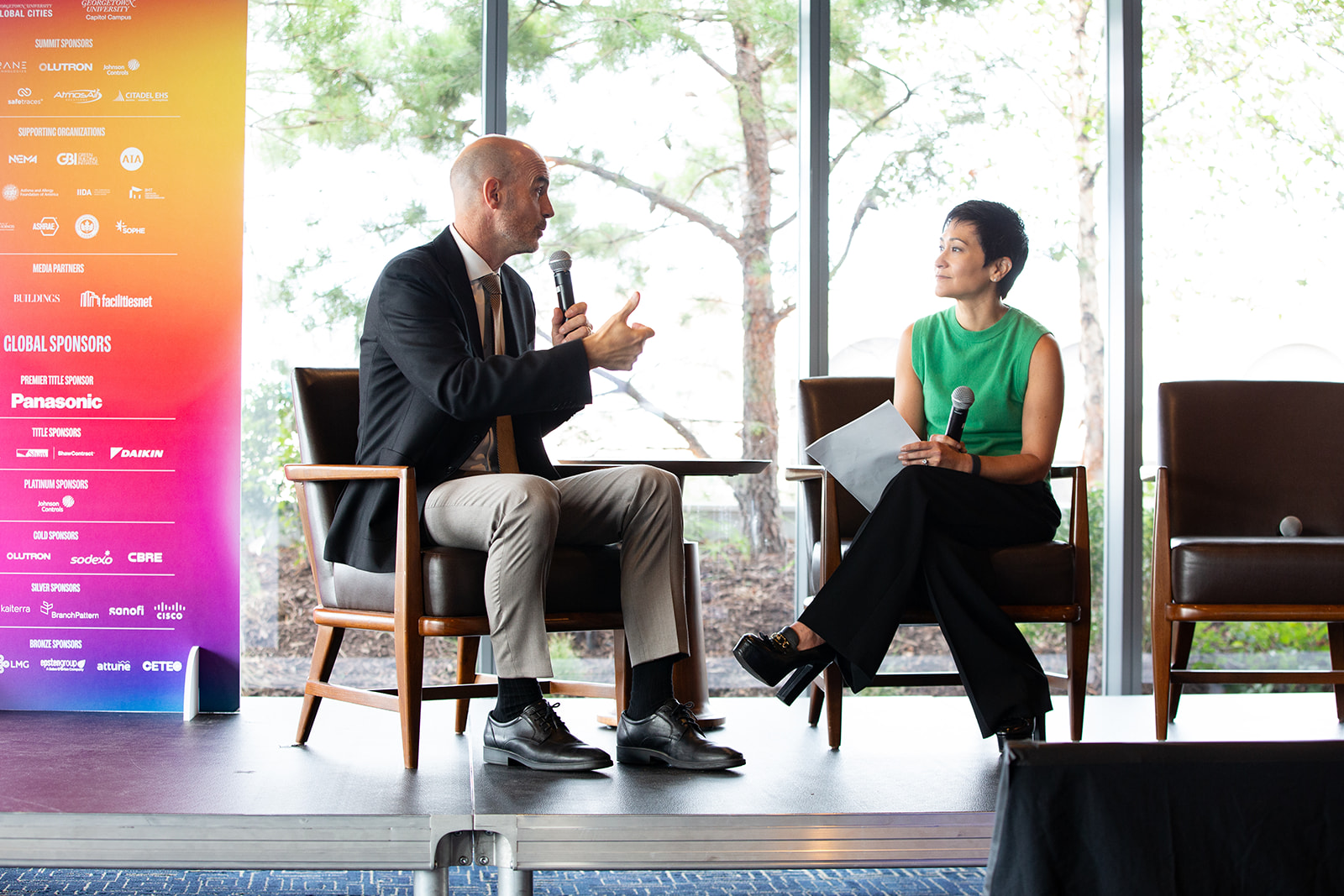
The laughter set the tone for IWBI’s Healthy Building Policy Summit’s opening plenary. Hodgdon, IWBI’s president and CEO, sat down with Dr. Joseph G. Allen, director of Harvard T.H. Chan School of Public Health’s Healthy Buildings Program, for a conversation that moved easily from home ventilation systems and lunchbox dilemmas to consequential questions about science, policy and public health.
Hodgdon wasted little time. How soon would continuous air quality monitoring become best practice? Allen’s response: it already is. Widespread adoption, he suggested, could be just three years away.
That optimism ran through the exchange. So did his insistence that progress requires more than promising technology.
The movement has momentum. We cannot stop explaining why it matters.
Allen rejected the idea that healthy buildings would fade from attention as pandemic fatigue set in. Public awareness has taken root, investment in sensing technologies is accelerating, and policy efforts are becoming more coordinated.
He credited IWBI’s global convening and highlighted the Global Commission on Healthy Indoor Air’s Framework for Action as evidence of a movement gaining strength.
But one of his biggest pandemic lessons was about persistence. Publishing an argument—even in The New York Times—does not mean the message has landed everywhere it needs to. His instruction to the room was simple: keep talking about it.
A sensor on the wall is only the beginning.
Hodgdon pressed Allen on why monitoring adoption remains slow as costs and technical barriers fall. His answer: the industry has not fully connected the data to its value.
Monitoring can help owners identify which buildings need attention, target maintenance and uncover energy savings. But someone needs to analyze the information and act on it. A dashboard alone will not deliver those benefits.
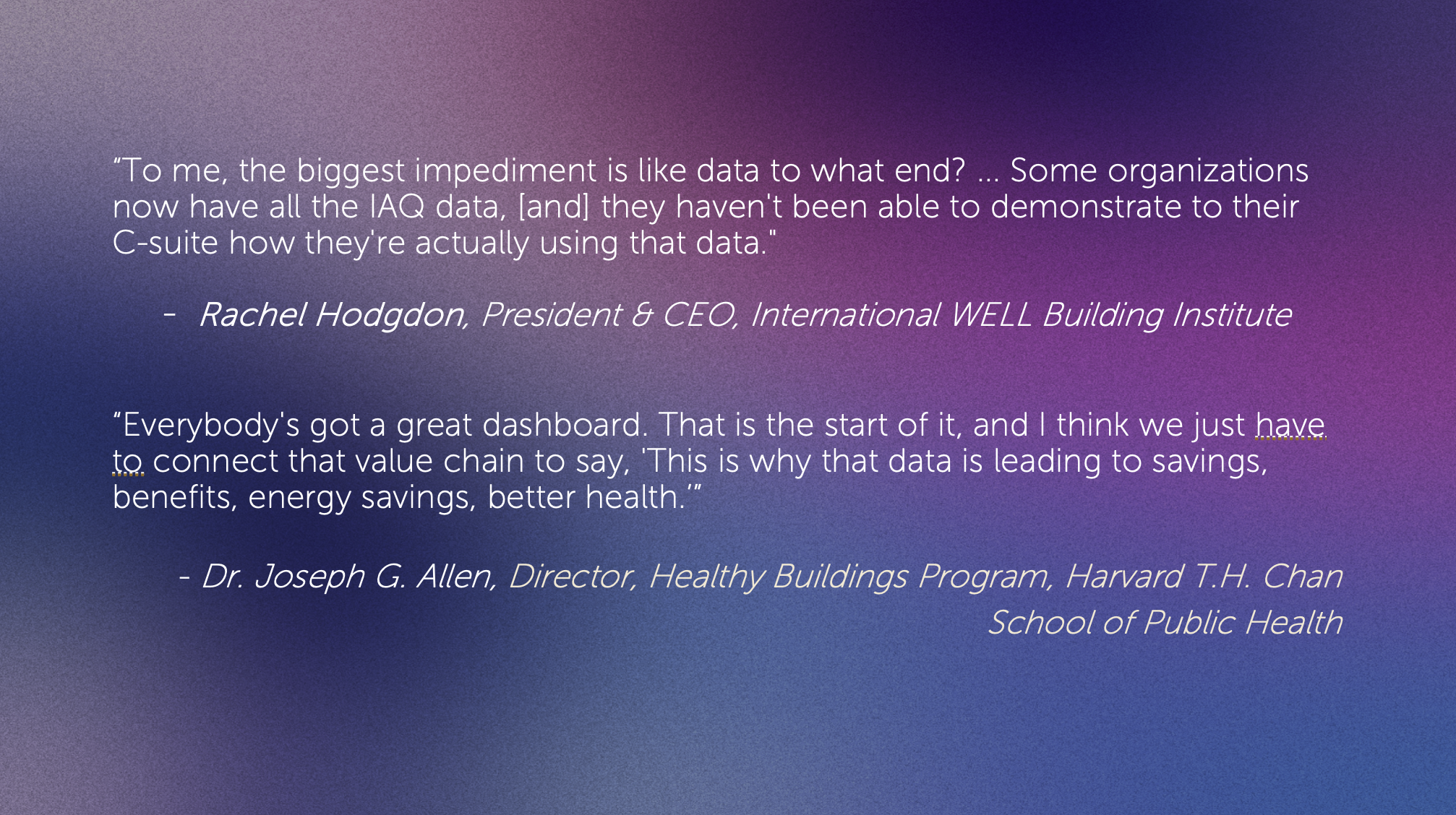
Hodgdon recognized the problem from conversations with organizations struggling to explain their monitoring investments to senior leadership. The missing piece is a system that turns measurements into decisions—and demonstrates what improved.
The next frontier includes what we put inside buildings.
Allen brought the conversation back to a fundamental principle of indoor air quality: source control.
Ventilation and filtration deserve attention, but so do the materials and products introducing chemicals into indoor air and dust. He described research finding hormonal activity in office dust samples and argued that healthier materials remain an under-addressed policy priority.
The challenge extends beyond asking consumers to make better choices. It requires changing the systems that determine which products reach buildings in the first place.
We need to study buildings over a lifetime.
One of Allen’s most consequential points concerned what health research leaves out. Long-running studies have shaped our understanding of smoking, diet and exercise. Buildings, he argued, need to become part of those studies, too.
Stronger evidence connecting indoor exposures with health outcomes over time could sharpen policy, strengthen investment decisions and help establish links between building performance and insurance incentives.
Make healthy choices easier—not more exhausting.
The system’s question became personal when Hodgdon confessed that choosing a lunchbox for her young son had become a weeks-long dilemma.
Allen’s response offered perspective: make good decisions without trying to eliminate every exposure yourself. His focus is on changing conditions so the next generation of parents does not face the same burden.
He closed by invoking Dr. Alice Hamilton, whose work challenged the belief that industrial illness was simply workers’ failure to keep clean. A century later, the struggle to recognize and address airborne exposures continues.
It was a fitting opening challenge for the summit: turn growing knowledge into systems that protect people—so healthy air, healthier materials and better buildings become things everyone can expect.