Clean Indoor Air: From Global Momentum to Everyday Protection
Policy is advancing. Technology is evolving. Now we need to make healthier indoor air common practice—in every kind of building.

From Australia to Singapore, Japan, the Philippines and North America, I’ve had the privilege of bringing indoor air quality experts, innovators and policymakers into conversation. Whether moderating a global forum or collaborating on a WELL project, I leave these exchanges more convinced that indoor air deserves to be front and center as a driver to create healthier places. Buildings shape our health, resilience and performance. Improving the air inside them means reducing public health risks and giving people greater opportunity to thrive.
That thinking was central to discussions I joined at Indoor Air 2026, the International Society of Indoor Air Quality and Climate’s conference in Singapore. It also informed my testimony before the New South Wales Parliament’s Clean Indoor Air Inquiry earlier this year in Australia. I’m excited that the New South Wales Legislative Council Health Committee’s landmark inquiry report, published in October 2026, reflected the recommendations IWBI made: stronger governance, monitoring and health-based performance standards to advance our indoor air quality. These are encouraging signs of momentum. The question is how we turn them into lasting change.
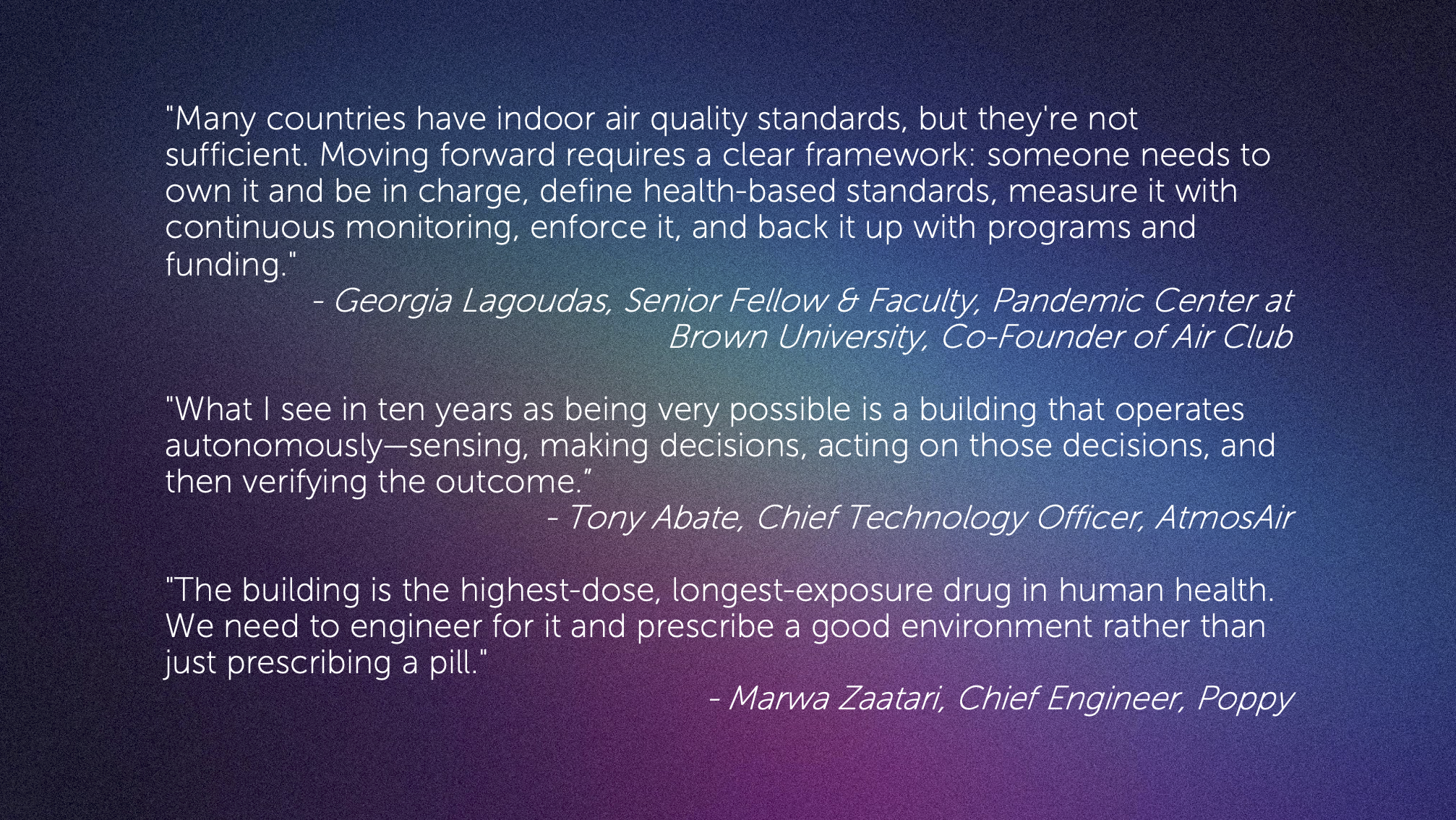
That was the purpose of IAQ Next: A Rapid-Fire Leadership Exchange at the 2026 IWBI’s Healthy Building Policy Summit. Joining me were Georgia Lagoudas, senior fellow and faculty at Brown University’s Pandemic Center and co-founder of Air Club; Tony Abate, chief technology officer at AtmosAir; and Marwa Zaatari, chief engineer at Poppy and chair of ASHRAE’s Center of Excellence for Indoor Environmental Quality.
Together, they brought perspectives on policy, engineering and technology deployment. I wanted to connect those perspectives around a practical sequence: what policy can enable, what technology must prove and what will make better air accessible beyond premium buildings.
What does the global policy picture tell us?
Georgia shared findings from Air Club’s newly published Global Indoor Air Quality Policy Database (with IWBI serving as a project partner), which covers 250 policies across 53 countries. Progress is real, but uneven.
Her framework offered a useful way forward: assign responsibility, define health-based standards, measure conditions, enforce requirements and provide support through funding and programs. Few countries have all five pieces. For policymakers, the opportunity is to build a complete system rather than rely on isolated measures.
Can buildings respond to airborne threats—and prove they are protecting people?
Marwa described Poppy’s work through the ARPA-H-supported SCALE program: developing biosensors, a live risk-assessment system and building controls that respond through measures such as ventilation and filtration.
The planned school deployments aim to test an important shift—from assuming that a building’s design delivers healthy air to measuring how it performs. She connected that ambition to standards that can raise expectations across ordinary buildings, including schools and older properties.
How do we know which clean air technologies to trust?
Tony’s answer started with defining the problem in the actual space. Laboratory results matter, but so do independent safety verification, field studies, integration with HVAC systems and long-term operating evidence.
Marwa reinforced the importance of matching the intervention to the risk. More outdoor air may help in one situation and introduce wildfire smoke in another. A technology that addresses pathogens may not address particles or allergens.
And we cannot overlook source control: removing pollutants at their source remains a fundamental part of healthier indoor air.
What will make better air common practice?
Georgia pointed to school districts where clear ownership, sustained monitoring and active use of data have helped programs endure. Health, maintenance and energy benefits can reinforce one another.
Tony emphasized simplicity. Operators need information that tells them whether something is wrong, what to do and whether the response worked.
Marwa challenged us to go further: health protection should not always have to justify itself through energy savings. We accept essential safety systems as part of operating a building. Indoor air quality deserves that same seriousness.
What should change next—and what could be normal in 10 years?
For the near term, the panel called for clearer definitions of good indoor air, measured performance in existing buildings and comprehensive policy leadership.
Their longer-term visions were compelling: air managed as deliberately as temperature; buildings that sense, respond and verify results; and accessible information that helps people understand the air around them.
Marwa helped me imagine a hopeful future: “Right now, we manage indoor air by hope—hoping the air we bring in or filter is good enough. In ten years, it will be unthinkable to send kids to schools where we don’t know what they’re breathing, and we will manage indoor air just like we manage temperature.”
Those are the expectations I want to help advance through our work at IWBI and every WELL project we engage with. The next chapter of IAQ must turn growing awareness into clear responsibility, verified performance and healthier spaces people can count on.