
A New Building Imperative: Public Health, Resilience and National Security
As biological threats and environmental risks evolve, buildings are becoming part of the conversation about national preparedness. At IWBI’s Healthy Building Policy Summit, leaders in the field explored what it takes to turn that recognition into everyday protection.

For Rebecca Katz, the question of how buildings can help detect emerging health threats has a practical urgency. A professor and director of Georgetown University’s Center for Global Health Science & Security, Katz runs a nongovernmental health security operations center initially established for the 2026 World Cup. The center brings together intelligence from multiple sources to help provide early warning to public health officials—and she has seen how buildings are now being integrated as part of that larger health defense system.
That perspective shaped the discussion at the IWBI Policy Summit around A New Imperative for Buildings: Public Health, Resilience and National Security. Bringing together expertise in pathogen detection, disease prevention and building operations, the session explored how healthier buildings could strengthen both daily public health and preparedness for larger threats.
Katz challenged the panelists with a practical question: once a building detects something, who receives that information, what can they do—and how quickly?
Buildings as early warning systems—and a first line of defense
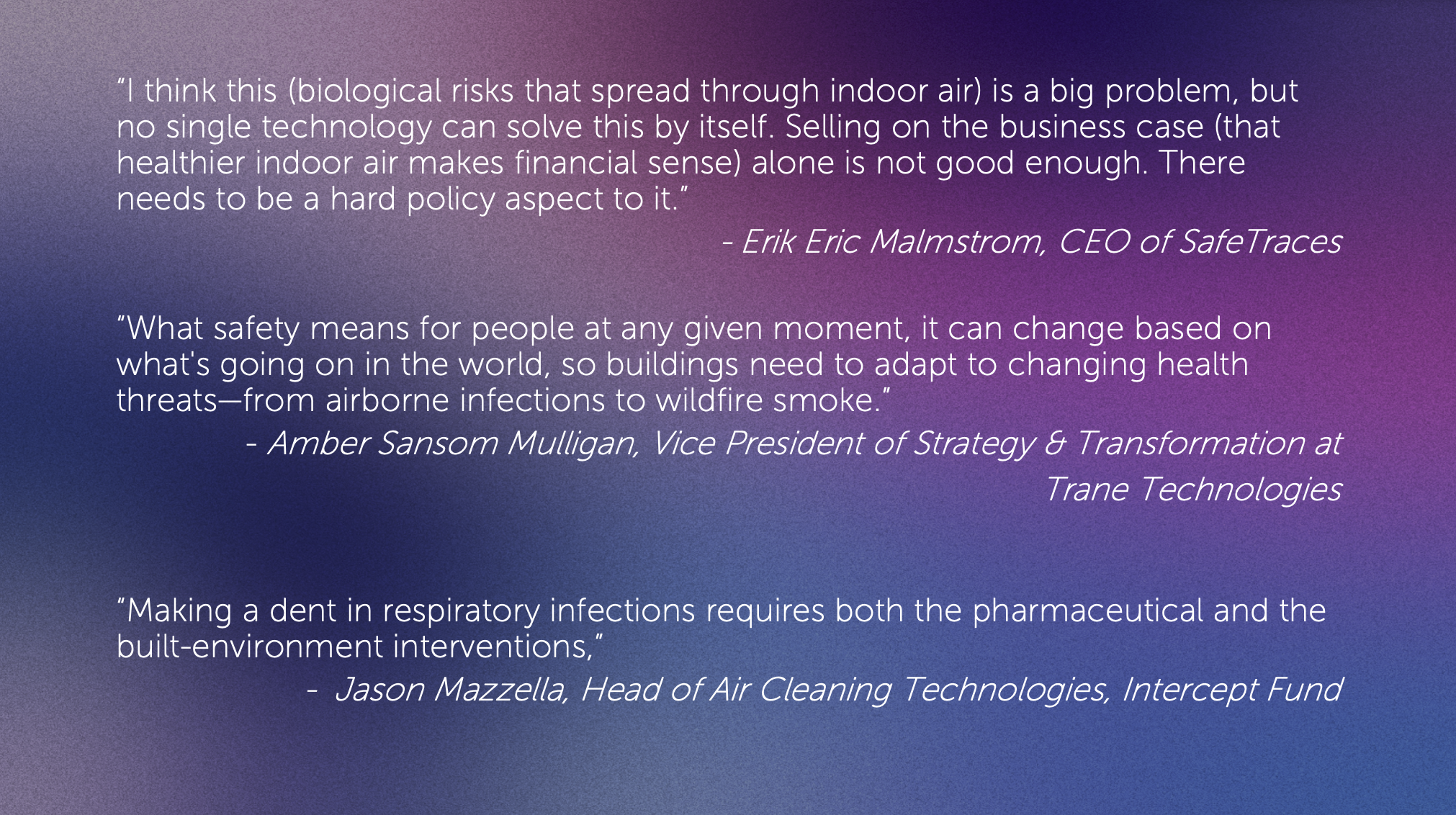
Erik Malmstrom, CEO of SafeTraces and an Army combat veteran, described two connected roles for buildings: identifying airborne threats earlier and helping reduce exposure before people become ill.
Yet the buildings and national security communities rarely work closely enough together, he argued. Connecting them requires recognizing that biological risks can disrupt critical infrastructure, undermine military readiness and affect entire communities.
Katz challenged the panel on the reliability of environmental monitoring, pointing to past problems with false alarms and missed detections. Malmstrom acknowledged the stakes: faster results are valuable only if they are accurate enough to support consequential decisions. Emerging technologies need to shorten detection times without sacrificing confidence in the data.
New capabilities need buildings that can respond
Amber Mulligan, vice president of strategy and transformation for commercial business at Trane Technologies, brought the discussion back to the infrastructure needed to act on those signals.
Building operators already face changing demands. Bringing in outdoor air to reduce infection risk requires a different response when wildfire smoke arrives. Controls, filtration and HVAC systems need to support decisions that reflect dynamic conditions inside and outside.
Her starting point was foundational to pressing issues all buildings face: address deferred maintenance, upgrade aging systems and improve visibility into building operations. Energy savings and available incentives can help make those improvements possible—and prepare buildings to integrate emerging health technologies.
Preparing for the next emergency can also reduce illness today
Jason Mazzella of Intercept, a relatively new $500 million philanthropy, connected that security ambition to a familiar experience: getting sick several times a year.
Intercept is pursuing preventive medicines alongside air cleaning technologies to eradicate respiratory infections. Building-based protections can help address gaps when medicines are not fully effective or accessible, while offering protection against a range of pathogens.
For Mazzella, accelerating adoption means understanding where decisions stall: awareness, evidence, product selection or funding. Demonstrating benefits that matter to different settings—from school attendance to workplace productivity—can help turn promising technologies into investments people are ready to make.

Who pays for protection—and what drives action?
The financing discussion exposed a broader question about value. Malmstrom suggested that the answer changes depending on whether healthier buildings are treated as public infrastructure, risk management or a private investment. The benefits may include fewer sick days, stronger operational continuity or improved mission readiness.
Mazzella pointed to philanthropic funding as a way to help early adopters demonstrate results, with public investment potentially supporting wider adoption. Malmstrom also argued that enforceable policy will be necessary to reach beyond organizations already motivated to act.
Katz closed by asking for progress within a year. The priorities were clear: reliable information that leads to action, building systems capable of responding, and funding and policy that extend protection. The new imperative is to connect those pieces—making buildings an active part of how communities prevent illness and prepare for what comes next.