
What Does It Take to Put Student Health First? Moving From Evidence to Action
At IWBI’s Healthy Building Policy Summit, education, public health and building experts tackled the policy gaps, funding barriers and everyday decisions standing between students and healthier places to learn.

Mold in classrooms. Capped fountains of undrinkable water. Aging ventilation systems. Environmental hazards inside and adjacent to school buildings. For too many students, these conditions disrupt learning and put health at risk, and the schools with the fewest resources face some of the toughest challenges.
That urgency drove the discussion on Health-First Schools and Colleges: Turning Momentum into Action at the 2026 IWBI’s Healthy Building Policy Summit. The session brought together expertise in children’s health, advocacy, environmental safety, building technology and campus planning to connect the scale of the problem with practical ways forward.
Moderator Nsedu Obot Witherspoon, executive director of the Children’s Environmental Health Network, framed the discussion around prevention and equity. Earlier this year, her organization CEHN joined with IWBI and fellow advocacy organizations to host the inaugural Healthy Schools for Healthy Kids Summit in August 2026, with a commitment to co-develop a Health-First Agenda for America’s Schools. This conversation continued that work, focusing on how to put the agenda into practice.
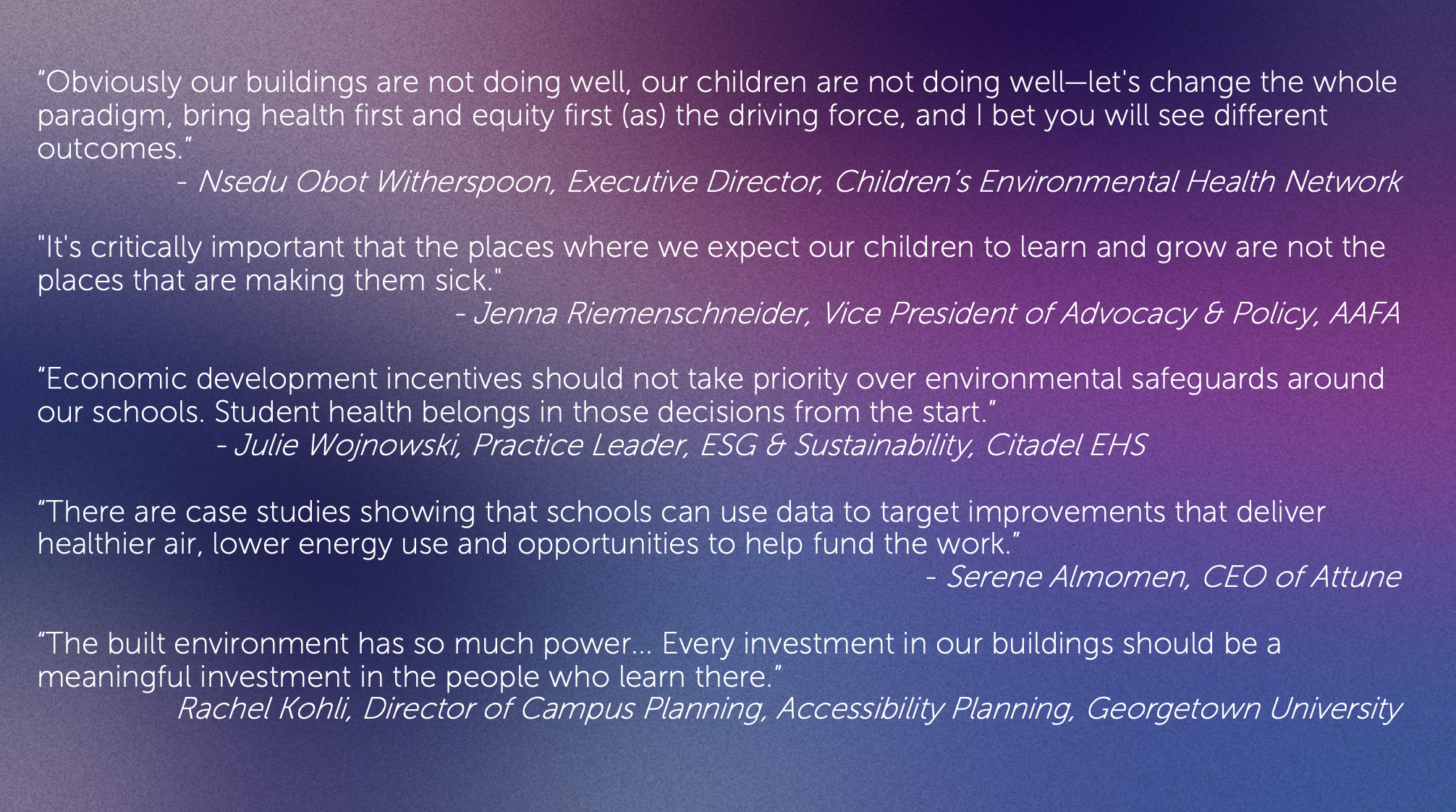
Jenna Riemenschneider, vice president of advocacy and policy at the Asthma and Allergy Foundation of America, laid out the stakes: asthma triggers in schools can keep children out of class, while uneven policies leave protection dependent on where students live. Standards matter, but schools also need the money and capacity to meet them. Adding requirements without addressing strained budgets will only get so far.
Julie Wojnowski, practice leader for ESG and sustainability at Citadel EHS, brought the reality of those conditions into focus. Her teams address widespread mold and moisture problems alongside lead and asbestos remediation in aging education buildings. She also highlighted a gap beyond school walls: development decisions, environmental safeguards and emergency planning are not always coordinated to protect nearby students.
There were encouraging examples, too. Serene Almomen, CEO of Attune, described how monitoring data helped a school in Virginia’s Prince William County make the case for HVAC upgrades. The improvements lowered carbon dioxide levels and sharply reduced complaints, while cutting energy use intensity by 74% and securing a $2.1 million utility rebate, she reported. The lesson: better information can guide investment, and health and energy improvements can support each other. This success case is part of her company’s Future-Ready Facilities Grant Program which allocated a $500,000 grant to award 25 school districts to modernize their infrastructure using smart monitoring technologies.
Rachel Kohli, director of campus planning and accessibility planning at Georgetown University, broadened the discussion to student well-being in higher education. Her work leverages data on student health needs to guide decision making. To her, campus investments need to address aging infrastructure while creating spaces where students can connect, feel supported and develop a sense of belonging.

Across these perspectives, a practical agenda emerged: pair protective policies with funding, use building data to target improvements, coordinate decisions beyond school property and make student well-being a priority in capital planning.
Witherspoon closed by challenging the audience to rethink what schools are designed to deliver. Students’ health and development should guide decisions from the beginning. Doing that can help communities move that work forward through school boards, local advocacy and everyday involvement.