Spotlight Conversation: Buildings as a Platform for Proactive Health Innovation
APRA-H, a federal health research initiative, is looking to an unlikely platform for new ways to prevent disease: the built environment. A spotlight conversation explores how—and why.

What if buildings could detect airborne health threats and respond before people become sick?
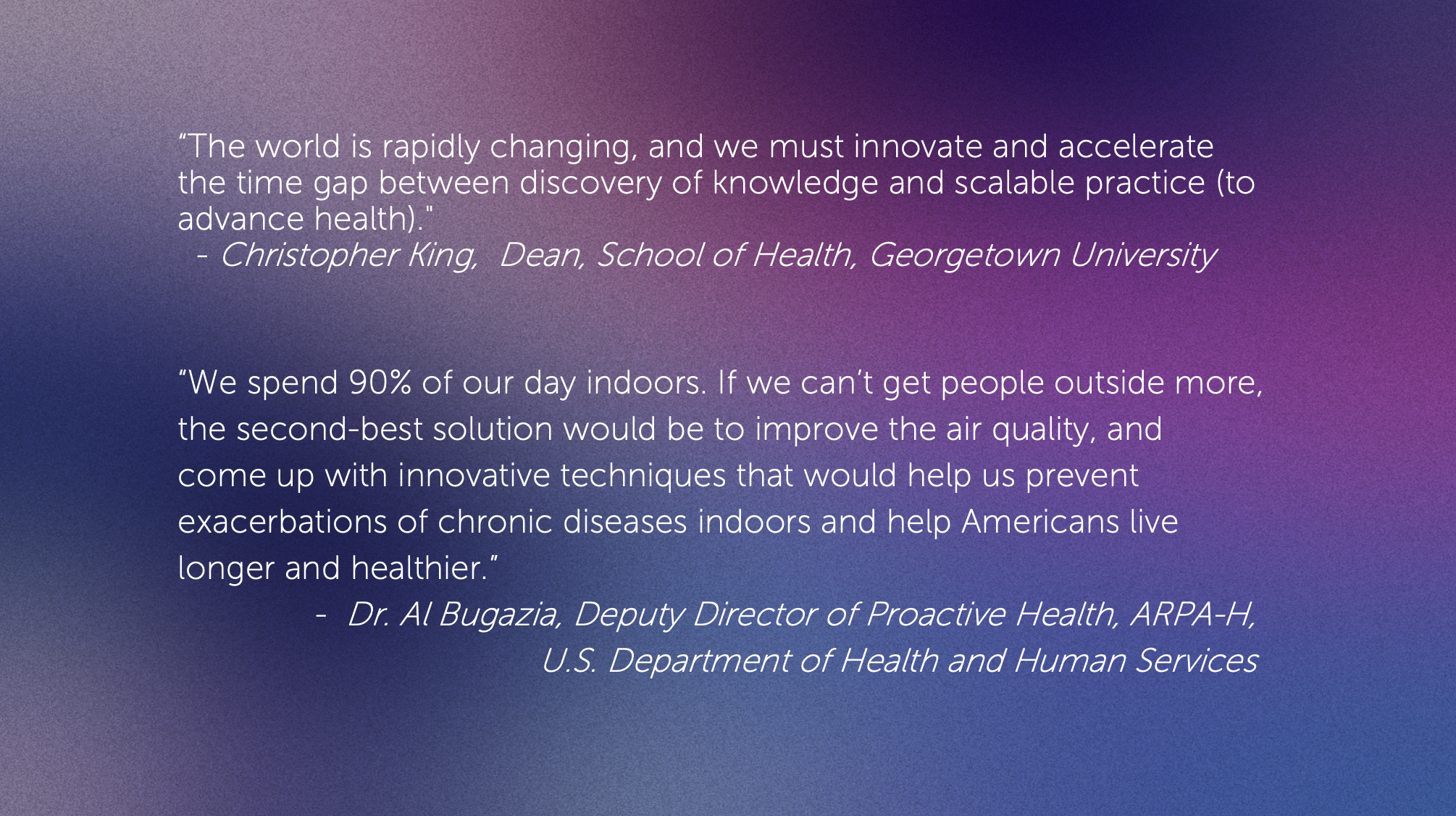
That question was part of the focus of a spotlight conversation between Christopher King, dean of Georgetown University’s School of Health, and Dr. Al Bugazia, deputy director of proactive health at the Advanced Research Projects Agency for Health (ARPA-H).
For Bugazia, the motivation is personal. After 13 years in intensive care, treating patients only to see them return “felt like pushing a rock uphill and watching it roll back down”. His own experience with severe childhood asthma reinforced the importance of preventing harmful exposures in the first place.
Why focus on buildings?
Because Americans spend most of their time indoors, making indoor air a powerful opportunity for prevention. Through BREATHE—Building Resilient Environments for Air and Total Health —ARPA-H is supporting technologies designed to help buildings detect airborne health threats and respond.
King recalled the program’s $156 million investment announced at the previous year’s policy summit. The ambition: make indoor environments an active part of keeping people healthy. The program generated enormous amounts of public interest and curiosity.
What would that look like in practice?
Bugazia described three connected capabilities: sense what is in the air, assess the risk and respond to improve conditions.
He compared the approach to an insulin pump. Having individual technologies is one thing; connecting them with the intelligence and infrastructure to act is what makes a functioning system. For buildings, that means moving from collecting information to using it to protect occupants.
How do you accelerate something this ambitious?
Bring people together—and fund progress differently.
Bugazia explained that collaboration across disciplines and technical areas is built into BREATHE’s approach. The teams developing sensing, risk assessment and response technologies need to work together so their solutions can work together, too.
King also asked him about ARPA-H’s funding model. Payments tied to defined milestones allow teams to assess results and adjust direction as needs evolve. Short timelines create urgency, while flexibility makes room to pursue promising discoveries.
And what makes a breakthrough worth pursuing?
Its potential to work in everyday life. Bugazia emphasized affordability, scalability and real-world effectiveness, alongside the need to address risks such as AI malfunction and cybersecurity.
He also made the case for learning along the way. An ambitious program can generate valuable discoveries even when it does not achieve every original goal.
The exchange was lively and often humorous, but its purpose was serious: shorten the distance between a pioneering idea and better health. For the healthy building community, ARPA-H’s approach opens an exciting question—are we only beginning to achieve the full potential of our buildings to protect our health and help us thrive?