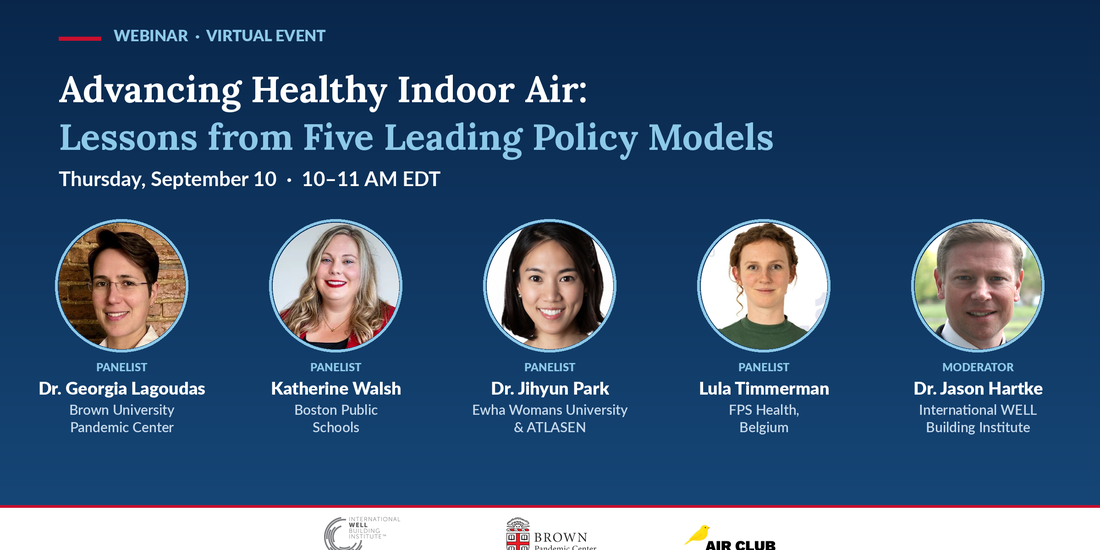
Lessons from Five Leading Policy Models for Advancing Healthy Indoor Air
A new report by the International WELL Building Institute, the Brown University Pandemic Center, and Air Club highlights a rapidly expanding wave of indoor air quality (IAQ) policy innovation across the globe
Over the past several years, healthy indoor air has emerged as a major global public health priority, fueled by growing awareness of its profound impact on human health, well-being, and economic benefits. A new report by the International WELL Building Institute, the Brown University Pandemic Center, and Air Club highlights a rapidly expanding wave of indoor air quality (IAQ) policy innovation across the globe. Drawing lessons from nearly 160 policies spanning 40 countries, the report identifies five leading policy models that governments are using to improve indoor air quality: (1) high-priority sectors, (2) transparency, (3) integrating health into building performance, (4) national coordination, and (5) dedicated IAQ law with enforcement.
Hear from the report’s authors and the policy innovators behind these pioneering approaches for a discussion on how these models were enacted and implemented, and how they can be adapted for other jurisdictions.