One WELL Revision Guide
IWBI's Chief Engineer, Nathan Stodola, walks through a comprehensive summary of every change in the new version of the WELL Standard.

Following a year of in-depth conversation with the community, the new version of the WELL Standard is available for public comment. The updates within this draft have been shaped by feedback from our global network of project teams and reviewers, and we hope that you see how your input has been incorporated throughout the draft. We now invite you to preview the changes and share your feedback through public comment now through May 1, 2026.
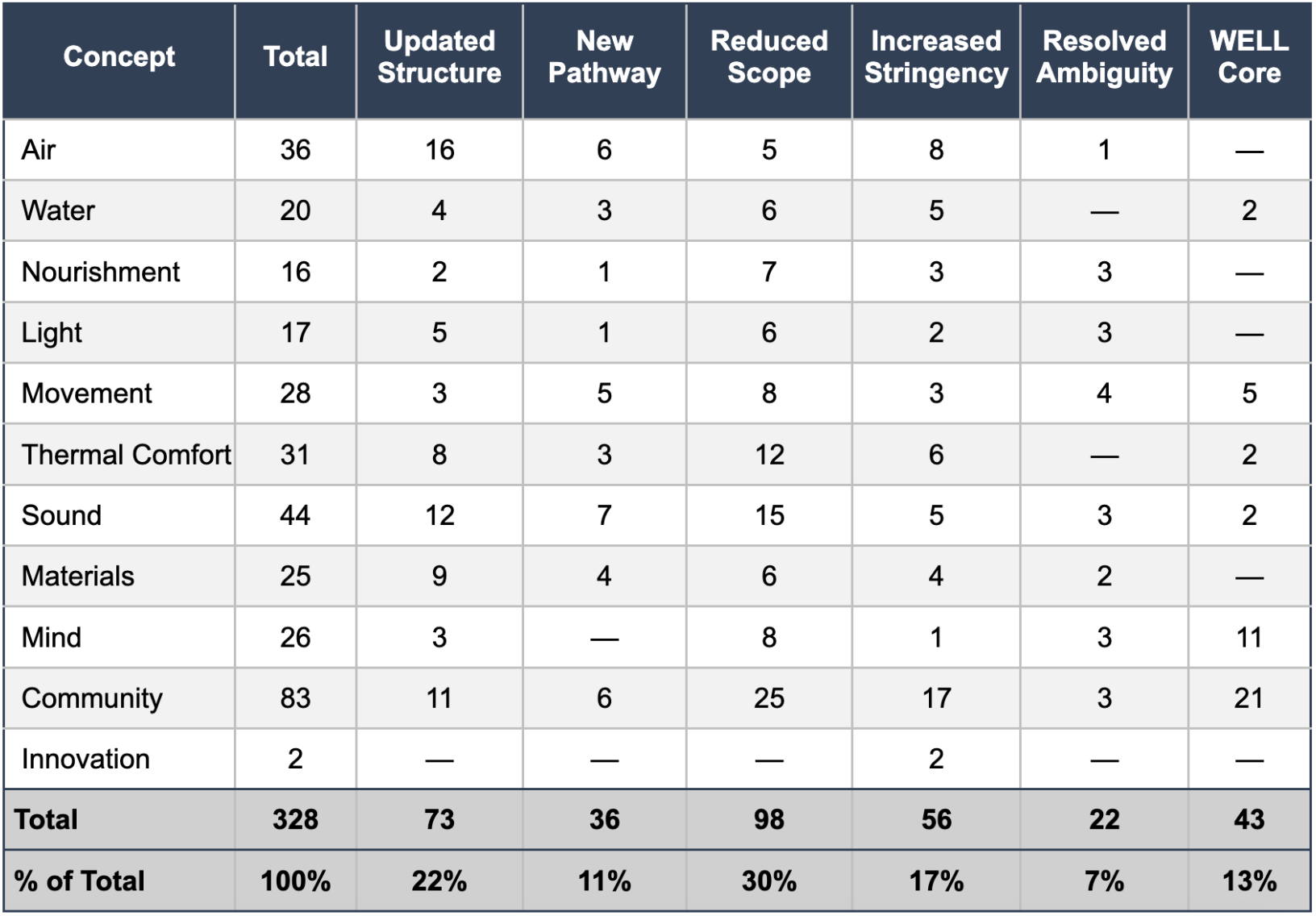
This guide is for anyone who wants to see all of the ways in which the next version of WELL compares with One WELL. It provides a comprehensive summary of every change in the new version of the WELL Standard, organized by concept and change type. The technical overview article, which introduces the vision, structure, and updated program rules behind One WELL, serves as a companion to this guide. As part of this version update, we have reorganized, expanded, streamlined, or strengthened all 212 WELL strategies. Read this guide to assess the specific impact on your projects and organizations. Reference the changelog in the standard library for the most granular, strategy-by-strategy comparison with WELL v2.
Data Driven Changes
Informed by extensive feedback from WELL clients and reviewers, we’ve restructured and simplified how each WELL strategy is written, making them more clear, scannable and straightforward to implement. These are the same WELL strategies you know and trust - underscored by a rigorous body of research.
As part of our clarity edits, we also reviewed feedback from project teams and reviewers about feasibility and impact. This resulted in additional changes that expand the ways in which you can comply, remove criteria to emphasize what’s most important to the health intent, and improve specificity to address instances of misinterpretation. Because this is a new version of WELL and not a typical addenda update, it includes a higher number of changes that result in increased stringency.
Key to Change Types
Below you can find a description of the six change types we have used to organize the changes made in the next version of WELL as compared with WELL v2. Throughout this article, we also call out changes to preconditions with a leading “(Precondition)” tag.
- Updated Structure:
Strategies were combined, split, or reorganized to either: clarify how related requirements build upon each other; better distinguish unique health intents; or generally clarify strategy language.
In some cases, language from the residential pilot was incorporated into strategies with similar scopes and intents.
-
New or Expanded Pathways:
New tiers, pathways, or novel strategies were added to broaden participation and reward additional types of achievement. -
Reduced Scope:
Requirements were narrowed, simplified, or removed to focus implementation on the highest-impact health criteria. -
Increased Stringency:
Requirements were strengthened based on new evidence, evolved best practices, or updated industry standards. In these cases, a legacy pathway will be made available, allowing the use of prior requirements for a period of three years. -
Resolved Ambiguity:
Requirements were clarified to prevent unintended misinterpretations that could undermine the health intent of the strategy. -
Updated WELL Core Scope:
WELL Core requirements were made more stringent or reduced to address feasibility or strengthen the impact of WELL Core projects on the buildings and people they serve. Because some changes in this change type expand the scope, clients utilizing WELL Core should review these changes carefully.
Metrics
Spotlight on Preconditions
This article presents a full digest of every change in the standard. The most substantive changes to note include the following changes to preconditions.
Reduced scope to address market feasibility
- Air quality, water quality, thermal comfort preconditions: Removed on-going annual testing requirements for projects pursuing WELL Certification. Ongoing monitoring of air and water quality is still awarded through optimization strategies.
- WELL v2’s A01.5 was retired. On-going monitoring of air quality parameters is covered in optimization strategy A1.1 and A1.2 (WELL v2 Feature Parts A08.1 and A08.2).
- WELL v2’s W03.1 was retired. On-going monitoring of water quality parameters is covered in optimization strategy W1.2 (WELL v2 Feature Part W05.1).
- WELL v2’s T01.2 Option 1 (semi-annual testing) was fully retired. On-going monitoring of thermal comfort parameters is covered in optimization strategy T1.1 (WELL v2 Feature Part T06.1).
- W2.1: Implement a Water Hygiene Plan for Building Water (WELL v2 Feature Part W03.2): Created a more streamlined and prescriptive compliance pathway for projects that do not have complicated water assets. This change provides more clarity on the actions and documentation requirements for these projects.
- N2.1: Provide Nutritional Information (WELL v2 Feature Part N02.1): Added a minimum scope that requires that food is prepared on-site to be eligible to earn this strategy. Projects that do not meet this minimum scope are not required to pursue this feature for WELL Certification.
- N1.2: Limit Sugar in Beverages (WELL v2 Feature Part N02.3): Reduced the scope to focus only on beverages.
- C1.2: Perform Annual Occupant Survey (WELL v2 Feature Parts C04.1, C04.2 C05.1):
- Removed requirements to ask about the following in the Environmental Satisfaction Survey:
- Demographics,
- Productivity,
- Engagement, and
- Self-rated health and well-being.
- Beyond the above, reduced the number of topics that need to be addressed in the Environmental Satisfaction Survey.
- Removed requirements to ask about the following in the Environmental Satisfaction Survey:
Increased stringency to reflect updated evidence on what constitutes health leadership:
- C1.2: Perform Annual Occupant Survey (WELL v2 Feature Parts C04.1, C04.2, C05…1): Required that the survey be completed before submitting for documentation review (or demonstrate that a contract is in place and an invoice has been paid to complete the survey within 12 months of earning this strategy) to ensure it is successfully administered.
- V1.3: Provide Adjustable Chairs (WELL v2 Feature Parts V02.3):
- Added a minimum adjustability range of 2 in for the adjustable seat pan path and changed the fixed seat pan path to 16.1-16.6 inches from 16.9 inches or less.
- Required recessed toe space at standing workstations instead of listing it as one of the possible compliance paths.
- C3.2: Implement Emergency Preparedness Plan and Training (WELL v2 Feature Parts C03.1):
- Added requirement to identify an emergency gathering place and to account for people during an evacuation or a shelter-in-place.
- Integrated requirements from WELL v2 Feature Parts C15.1 and M03.4 that require actions to facilitate post-event recovery.
Updated WELL Core scope:
- C1.2 Perform Annual Occupant Survey (WELL v2 Feature Parts C04.1, C04.2 C05.1): Increased the core scope from direct staff to the whole building paired with the following changes to the defined eligible population for core projects:
- For the environmental satisfaction survey, the eligible population includes:
- building management staff
- all building occupants or at least one representative from each tenant who has been designated by the tenant organization to interface with the landlord (e.g. for regular communications, to report issues, etc.)
- For the employee experience survey, the eligible population includes building management staff.
- For the environmental satisfaction survey, the eligible population includes:
- T4.3 Achieve Thermal Comfort Satisfaction (WELL v2 Feature T01 Option 3 and T02.1): Increased scope from non-leased space to the whole building.
- M1.1 Promote Mental Health and Well-being (WELL v2 Feature Part M01.1): Increased scope from direct staff to building management staff.
Retired WELL v2 Feature Parts
- WELL v2’s S01.1 Label Acoustic Zones was formally retired.
- The new version of the standard clearly defines rooms/spaces throughout the concept which allowed us to eliminate this precondition entirely. S01 Part 2 remains and addresses holistic acoustic planning and now incentivizes working with an acoustics professional.
- WELL v2’s X02.3 Manage Polychlorinated Biphenyl (PCB) Hazards was formally retired. This topic is addressed through the majority of global materials regulations.
Air
Structural Changes (applies to 16 changes across 11 strategies).
- A1.3: Monitor Outdoor Air Quality (A07.2-1)–Separated requirements from WELL v2 Feature A07.2 about management of window use into its own strategy.
- (Precondition) A2.1: Prohibit Smoking (A02.1 / A02.2)
- Combined WELL v2 Feature Parts A02.1 and A02.2 into a single strategy.
- Expanded the requirements to address smoking bans in residential projects by incorporating language from the WELL for residential pilot.
- (Precondition) A3.1: Supply Outdoor Air (A03.1)
- Combined the design pathways of WELL v2 Features A03.1 and A06.1 into tiers in this strategy.
- Separated requirements from WELL v2 Feature A03.1 regarding mechanical exhaust into its own strategy.
- Split requirements from WELL v2 Feature A11.1 regarding commercial and residential kitchen exhaust into standalone strategy, and incorporated language from the WELL for residential pilot.
- Expanded the requirements to address dwelling units by integrating strategies from the WELL for residential pilot (Note: There is no baseline requirement for supplied air in dwelling units).
- (Precondition) A3.5: Provide mechanical exhaust systems
- Combined the mechanical exhaust aspects of WELL Features A03.1 and A11.1 into a single strategy
- Combined requirements for kitchen and bathroom exhaust in residential projects by incorporating language from the WELL for residential pilot into the requirements from WELL v2 Feature A11.1.
- A4.1: Design Healthy Entryways (A09.1) — Incorporated requirements from the WELL for residential pilot
- A4.3: Manage Window Use (A07.2-2) — Separated WELL v2 Feature Part A07.2 into two distinct strategies that address outdoor air measurements and management of window use, respectively. This strategy focuses on managing window use.
- A5.3: Manage Infectious Aerosols in Indoor Air (A13.2) — Combined requirements addressing infectious particles—previously WELL v2 Feature Part A13.1—into the new Tier 1 of this strategy. Also, reorganized requirements addressing infectious disease management mode and routine operations into separate tiers.
- (Precondition) A6.1: Meet Thresholds for Particulate Matter (A01.1 / A05.1) — Combined WELL v2 Feature Parts A01.1 and A05.1 into a single, tiered strategy. Removed pathways allowing for higher thresholds of particulates (these will be re-published as AAPs).
- (Precondition) A6.2: Meet Thresholds for Organic Gases (A01.2 / A05.2) — Combined WELL v2 Feature Parts A01.2 and A05.2 into a single, tiered strategy.
- (Precondition) A6.3: Meet Thresholds for Inorganic Gases (A01.3 / A05.3) — Combined WELL v2 Feature Parts A01.3 and A05.3 into a single, tiered strategy.
- (Precondition) A6.4: Meet Thresholds for Radon (A01.4) — Separated requirements regarding mechanical ventilation to A3.1. This strategy now addresses radon testing exclusively.
New or Expanded Pathways (applies to 6 changes across 6 strategies)
- A1.2: Promote Air Quality Awareness (A08.2) — As an alternative to displaying results from continuous monitoring, added pathway, based on aspects of WELL v2 Feature A01.5, to display results from on-site tests taken within the last year by a WELL Performance Testing Agent in accordance with the WELL Performance Verification Guidebook
- (Precondition) A2.1: Prohibit Smoking (A02.1 / A02.2) — Integrated existing alternative adherence paths (AAPs) into strategy language as additional pathways.
- A3.2: Test Ventilation Performance (NEW) — Added a new strategy to the Air Concept. This strategy focuses on measuring ventilation and assessing filtration capacity on a regular basis and was inspired by WELL Feature SA1 in the WELL Health Safety Rating.
- A4.1: Design Healthy Entryways (A09.1) — Incorporated new pathways, allowances, and exclusions from published AAPs into this strategy.
- (Precondition) A6.4: Meet Thresholds for Radon (A01.4) — Added a new tier to earn additional points for meeting a more stringent radon threshold across more of the total floor area.
- A6.5: Meet Thresholds for Carbon Dioxide (A06.1-Opt4) — This is a new standalone strategy for meeting carbon dioxide thresholds, which was previously incorporated as pathways within WELL v2 Features A03 and A06.
(A06.1-Opt4) — This is a new standalone strategy for meeting carbon dioxide thresholds, which was previously incorporated as pathways within WELL v2 Features A03 and A06
- A2.3: Minimize Combustion Sources (A10.1) — Reduced the scope of the vehicle idling ban to the project boundary, rather than all areas within the project’s control.
- A3.4: Isolate Pollution Sources (A11.1) — Removed all requirements regarding mechanical exhaust, consolidating them into A3.2 instead.
- A4.1: Design Healthy Entryways (A09.1) – Removed requirements for entryway design in outdoor sport areas.
- A4.3: Manage Window Use (A07.2-2) — Removed temperature from the list of parameters that projects must consider when managing window use.
- A5.2: Manage VOCs in Indoor Air (A13.1) — Reduced the scope of the strategy to VOCs only.
Increased Stringency (applies to 8 changes across 7 strategies)
- A1.2: Promote Air Quality Awareness (A08.2) — Changed the number of air quality displays to match the number of required sensors. Depending on project size, this may slightly increase or decrease the number of displays required.
- A1.3: Monitor Outdoor Air Quality (A07.2-1) — Decreased the allowable distance of measurements from the project to 0.25 mi.
- (Precondition) A2.2: Mitigate Construction Pollution (A04.1) — Required that the construction rules exist in a written policy.
- A3.4: Isolate Pollution Sources (A11.1)
- Expanded the requirements to address parking areas by integrating strategies from the WELL for residential pilot, which are applicable to all building types
- Expanded the requirements to address air intake location by integrating strategies from the WELL for residential pilot, which are applicable to all building types.
- A5.1: Manage Particulates in Supply Air (A12.1) — Required that filtration maintenance procedures are formally documented within a maintenance plan.
- A5.4: Implement Ultraviolet Treatment for Cooling Systems (A14.1) — Required that UVGI maintenance procedures are formally documented within a maintenance plan.
- (Precondition) A6.1: Meet Thresholds for Particulate Matter (A01.1 / A05.1) — Increased the stringency of the thresholds for both PM2.5 and PM10 in the highest tier, aligned with updated World Health Organization (WHO) air quality guidelines.
Resolved Ambiguity (applies to 1 changes across 1 strategies)
- A4.1: Design Healthy Entryways (A09.1) – Clarified that small gaps for transitions are permitted.
Water
Structural Changes (applies to 4 changes across 3 strategies)
- W1.1: Assess Drinking Water Quality (W05.1a) — Split WELL v2 Feature Part W05.1 into two distinct strategies: one for pre-testing of building water (W1.1) and one for ongoing testing of drinking water (W1.2 Tier 2).
- W1.2: Monitor Drinking Water Quality (W05.1b)
- Merged the monitoring section of WELL v2 Feature Part W05.1 with the basic monitoring requirements of WELL v2 Feature Part W03.1.
- Split WELL v2 Feature Part W05.1 into two distinct strategies: one for pre-testing of building water (W1.1) and one for ongoing testing of drinking water (W1.2).
- (Precondition) W4.2: Provide Drinking Water that Meets Thresholds for Chemicals (W02.1) — Integrated R-W02.2 Water testing as a point-earning opportunity at Tier 1 (Note: this pathway does not fulfill the minimum required strategies for WELL Certification but may be used to obtain other achievements).
New or Expanded Pathways (applies to 3 changes across 3 strategies)
- W1.2: Monitor Drinking Water Quality (W05.1b) — Added new pathways for biological measurement instead of only coliforms testing in Tier 2.
- (Precondition) W2.1: Implement a Water Hygiene Plan for Building Water (W03.1) — Added a new pathway for a basic water hygiene plan for projects that do not manage recirculating hot water loops and do not have complex water assets (such as spa pools or cooling towers).
- (Precondition) W4.2: Provide Drinking Water that Meets Thresholds for Chemicals (W02.1) — Added new pathway with a reduced scope to test only for lead, copper, and disinfectants (Note: this pathway does not fulfill the minimum required strategies for WELL Certification).
Reduced Scope (applies to 6 changes across 4 strategies)
- W1.1: Assess Drinking Water Quality (W05.1a) — Allowed to select between Benzene, Arsenic, Nitrate, and Coliforms testing instead of requiring all of these.
- W1.2: Monitor Drinking Water Quality (W05.1b)
- Reduced the water quality parameter scope in Tier 1. Teams may now select between total dissolved solids (TDS) and turbidity, rather than being required to test for turbidity.
- Reduced the testing frequency to every 6 months in Tier 2 (Former W05.1 section ‘Water quality monitoring’).
- For Tier 2 (W05.1b), reduced the scope of action when adverse results are found, requiring a list of suggested corrective actions instead of mandating corrections and retesting after a month.
- W2.2: Implement a Water Hygiene Plan for Non-Potable Water Capture and Reuse (W09.1) — Removed requisite to post conspicuous signage to highlight the safety features and conservation goals of the non-potable water system.
- W4.5: Provide Access to Drinking Water(W06.1) — Reduced the frequency of cleaning of drinking water stations from daily to weekly
Increased Stringency (applies to 5 changes across 4 strategies)
- W1.1: Assess Drinking Water Quality (W05.1a)
- Added total organic carbon and heterotrophic plate counts (HPC) measurements
- Required re-assessment of water quality following construction or extended vacancy.
- W1.2: Monitor Drinking Water Quality (W05.1b) — Added criteria for results reporting in Tier 1 (Formerly W03.1) that includes describing main findings and suggesting corrective actions.
- W3.1: Design Building Envelope for Moisture Protection (W07.1) — Added irrigation and local water table to the water sources that must be considered in the site drainage plan.
- W4.5: Provide Access to Drinking Water (W06.1) — Required that newly installed drinking water stations equipped with filters to include a notification system for required filter maintenance, such as a light or online alert.
WELL Core Scope Changes
- W3.2: Design Building Envelope for Moisture Protection
- Reduced the WELL Core scope for the base point to the scope of the developer’s fit out; added an additional point for whole building compliance.
- Added an additional point opportunity for implementing in the whole building.
Nourishment
Structural Changes (applies to 2 changes across 2 strategies)
- (Precondition) N1.1: Provide and Promote Fruits and Vegetables (N01.1 / N01.2) — Combined WELL v2 Feature Parts N01.1 and N01.2 and previous requirements for all spaces and commercial kitchens into a single, tiered strategy. Higher tiers correspond to additional fruit and vegetable offerings.
- N1.2: Limit Sugar in Beverages (N02.3 / N03.1) — Combined WELL v2 Feature Parts N02.3 and N03.1 into a single, tiered strategy.
New or Expanded Pathways (applies to 1 change across 1 strategy)
- N2.2 Provide Ingredient Information (N05.1 / N02.3B) — Replaced WELL v2 N05.1 with a new beta strategy that addresses primary and compound ingredients.
Reduced Scope (applies to 7 changes across 6 strategies)
- N1.2: Limit Sugar in Beverages (N02.3 / N03.1) — Reduced the scope to focus only on beverages.
- N1.4: Provide Meal Size Variety (N06.1) — Removed requirements for calorie-based meal sizes. More general paths for smaller portions are now available.
- N1.5: Provide Meals that Accommodate Dietary Needs (N09.1) — Removed gluten from the list of meal choices. Gluten-free needs are addressed through the existing wheat-free meal requirement.
- (Precondition) N2.1: Provide Nutritional Information (N02.1) — Added a minimum scope that requires that food is prepared on-site to be eligible to earn this strategy. Projects that do not meet this minimum scope are not required to pursue this feature for WELL Certification.
- N2.4: Label Allergens for Foods and Beverages (N09.2) — Removed gluten from the list of food allergens required to be labeled. Wheat remains on the required list.
- N3.1: Provide Spaces for Mindful Eating (N08.1)
- Removed the policy requirement for meal breaks. The strategy now addresses design of mindful eating spaces only.
- Removed peak occupancy from the occupancy calculation method.
Increased Stringency (applies to 3 changes across 2 strategies)
- N3.4: Provide Proximity to Fruits and Vegetables (N13.1)
- Removed option for projects to host weekly temporary sales, such as fruit stands or mobile markets.
- Removed the transit-to-farmers-market option.
- N4.1: Promote Healthy Nutrition Messaging (N04.1) — Required that restrictions for unhealthy food advertising must be explicitly stated in a policy.
Resolved Ambiguity (applies to 3 changes across 3 strategies)
- N1.2: Limit Sugar in Beverages (N02.3 / N03.1) — Added a minimum scope of at least three distinct beverages sold or provided.
- N1.4: Provide Meal Size Variety (N06.1) — Required that at least 50% of all meals are offered in a smaller portion.
- N3.4: Provide Proximity to Fruits and Vegetables (N13.1) — Established the minimum quantity of fruit and vegetable offerings that a grocery store must provide to count.
Light
Structural Changes (applies to 5 changes across 4 strategies)
- (Precondition) L1.1: Design Space Layout for Daylight (L01.1 / L05.1) — Combined WELL v2 Feature Parts L01.1 (design pathways) and L05.1 into a single, tiered strategy.
- (Precondition) L1.3: Conduct Daylight Simulation (L06.1)
- Combined WELL v2 Feature Parts L01.1 (daylight modeling pathway) and L06.1 into a single tiered strategy.
- Reorganized strategy so that the pathway of including one or more common areas that has been modeled to have exceptional daylight is now an AAP.
- L3.1: Implement Lighting Zones and Control Systems (L09.1) — Reorganized to include language regarding controllability exclusions directly into requirements instead of a separate Note.
-L3.2: Provide Supplemental Lighting (L09.2) — Reorganized strategy so that the policy pathway to provide adjustable lights is now an AAP.
New or Expanded Pathways (applies to 1 change across 1 strategy)
- L1.2: Implement Solar Shading (L05.2) — Expanded “open” and “closing” of shades to include “lighten” and “darken” the window to account for an increasing variety of shading strategies, such as electrochromic glass.
Reduced Scope (applies to 6 changes across 5 strategies)
-
(Precondition) L2.1: Meet Lighting Thresholds for Visual Acuity (L02.1) — Removed reference to the ages of the occupants in the design process. Age considerations are determined by the selected lighting reference.
-
L2.3: Design Lighting for Visual Balance (L07.1) — Removed pathway regarding lighting automation and decreased the quantity of requirements to be met in Parameters for visual balance from three to two.
-
L3.1: Implement Lighting Zones and Control Systems (L09.1)
- Removed the requirement that the distribution, CCT, or color of the lights is adjustable.
- Decreased the required brightness adjustment settings from three to two.
-
L4.1: Manage Glare from Electric Lighting (L04.1) — Reduced the luminaire requirement from 100% of the light above the horizontal plane to 90% of the light above the horizontal plane.
-
L4.2: Enhance Color Rendering (L08.1) — Removed the requirements for color quality in circulation areas.
Increased Stringency (applies to 2 changes across 2 strategies)
-
(Precondition) L1.3: Conduct Daylight Simulation (L06.1) — Aligned Tier 3 with CEN17037 methodology, updating the second threshold from the average illuminance of 100 Lux to the minimum illuminance of 100 Lux for 50% of day lit hours.
-
L4.2: Enhance Color Rendering (L08.1) — Removed the pathway of using the average CRI ≥ 80 plus Ra ≥ 50, as this information is rarely available from lighting manufacturers.
Resolved Ambiguity (applies to 3 changes across 2 strategies)
- L1.2: Implement Solar Shading (L05.2) — Required that shades must open at least once a day in Tier 2 in addition to Tier 1.
-
L4.1: Manage Glare from Electric Lighting (L04.1)
-
Expanded that the concealed lighting features refers to luminaires whose light sources are concealed from normal points of view, such as wall washes and under-cabinet lightings, and does not include recessed ceiling lights.
-
Expanded that in the UGR path in Luminaire performance, the product’s UGR value must be for the design conditions closest to those for the space the light is installed in.
-
Movement
Structural Changes (applies to 3 changes across 3 strategies)
- (Precondition) V1.2: Provide Adjustable or Active Workstations (V02.2 / V02.4 / V07.1): Combined these parts into a single, tiered strategy.
- V1.5: Implement an Ergonomics Program (V11.1): Now requires ergonomic assessments, commitment to needs, and specific education topics.
- V1.6: Inform furniture selections through a task analysis (V11.2): Now requires a task analysis to inform furniture selection.
New or Expanded Pathways (applies to changes across 5 strategies)
- (Precondition) V1.3: Provide Adjustable Chairs (V02.3): Added pathway for global ergonomic standards.
- (Precondition) V2.4: Provide Cycling Infrastructure (V04.1): Added flexible calculations for bike parking based on visitors or project size.
- (Precondition) V2.6: Select Sites with Pedestrian-Friendly Streets (V05.1): Added walkability indices pathway.
- (Precondition) V2.7: Select Sites with Access to Mass Transit (V05.2): Added a lower tier for greater distances.
- (Precondition) V3.2: Provide Indoor Physical Activity Spaces (V08.1): Added pathway for accessible fitness spaces.
Reduced Scope (applies to 8 changes across 5 strategies)
- (Precondition) V2.4: Provide Cycling Infrastructure (V04.1): Reduced required destinations to 5 and long-term parking to 2 spaces.
- (Precondition) V2.5: Provide Showers, Lockers and Changing Facilities (V04.2): Clarified locker quantities based on “required” rather than “provided” showers.
- (Precondition) V2.6: Select Sites with Pedestrian-Friendly Streets (V05.1): Reduced sidewalk requirements to one side of the street and street connectivity to 3 connections.
- V3.4: Promote Physical Activity (V09.1): Removed utilization rate requirements for incentive programs.
- V3.5: Provide Self-Monitoring Tools (V10.1): Removed minimum subsidy threshold.
Increased Stringency (applies to 3 changes across 3 strategies)
- (Precondition) V1.2: Provide Adjustable or Active Workstations: Required recessed toe space at standing workstations.
- (Precondition) V1.3: Provide Adjustable Chairs: Added a minimum adjustability range of 2 inches for the seat pan.
- (Precondition) V2.6: Select Sites with Pedestrian-Friendly Streets: Increased required facade design characteristics to 2.
Resolved Ambiguity (applies to 4 changes across 4 strategies)
- (Precondition) V1.2: Provide Adjustable or Active Workstations (V02.2 / V02.4 / V07.1) — Required that at least 25% workstations must be height-adjustable for Tiers 2 and 3, in addition to Tier 1.
- (Precondition) V2.5: Provide Showers, Lockers and Changing Facilities (V04.2) — Clarified that lockers must be located in the same room as showers and changing facilities.
- (Precondition) V3.3: Provide Outdoor Physical Activity Spaces (V08.2) — Restricted the types of spaces that can count toward this strategy to only those that directly promote physical activity.
- V3.5: Provide Self-Monitoring Tools (V10.1) — Clarified that projects must subsidize device memberships (if required for the device to work) for at least 1 year.
WELL Core Scope Changes
- (Precondition) V1.4: Provide Ergonomic Support Equipment — Updated WELL Core scope from non-leased to base building furnishings.
- V1.5: Implement an Ergonomics Program — Updated applicability from direct staff to building management staff.
- V1.6: Inform furniture selections through a task analysis — Updated applicability from direct staff to building management staff.
- (Precondition) V3.2: Provide Indoor Physical Activity Spaces — Added a new additional point for whole building physical activity space under WELL Core.
- V3.4: Promote Physical Activity — Updated applicability from direct staff to building management staff.
Thermal Comfort
Structural Changes (applies to 8 changes across 5 strategies)
- T2.1: Implement Radiant Heating (T05.1)
- Clarified that some amount of pre-heating is allowed, as long as the majority of the heating is done by the radiant system.
- Incorporated a FAQ on steam radiators from WELL v2 Feature T05.1 into strategy language.
- T2.2: Implement Radiant Cooling (T05.2) — Clarified that some amount of pre-cooling is allowed, as long as the majority of the cooling is done by the radiant system.
- T2.3: Provide Shade Outdoors (T09.1-Op1):
- Separated outdoor shading from the temperature modeling strategy, making both independently achievable.
- T3.5: Provide Operable Windows (A07.1)— Moved this strategy from Air to Thermal Comfort.
- (Precondition) T4.1: Provide Comfortable Thermal Environment (T01.1)
- Removed the pathway using thermal comfort survey results from this strategy. This pathway now exists only in T4.3.
- Reorganized the display of strategy language for clarity.
New or Expanded Pathways (applies to 3 changes across 2 strategies)
- T2.4: Manage Heat Outdoors (T09.1-Op2) — Added a pathway for project teams to implement heat-resistant surfaces in lieu of thermal modeling
- T4.1: Provide Comfortable Thermal Environment (T01.1)
- Incorporated several AAPs from WELL v2 Feature T01.1 into strategy language.
- Added pathway for project teams to select the standardized temperature range of 70-77°F (21-25°C) even if they are not using continuous monitors for on-site verification.
Reduced Scope (applies to 12 changes across 7 strategies)
- T2.3: Provide Shade Outdoors (T09.1-Op1)
- Removed plazas and areas of congregation without seating from the scope of this strategy.
- Simplified the shading calculations to require shading to be assessed only on the summer solstice, instead of every day.
- T3.1: Providing Thermal Zoning (T03.1) — Removed the requirements for thermal zones to have independent temperature setpoints and for them to be individually controlled by occupants.
- T3.2: Provide Personal Heating Options (T04.2) — Removed the requirements to demonstrate a plan for cleaning blankets.
- T3.5: Provide Operable Windows (A07.1) — Removed the requirement that some projects, based on the outdoor air quality, may not earn this feature unless they also earn additional window operation strategies (A4.3).
- T3.6: Provide Windows with Multiple Opening Modes (T08.1) — Removed the required instructions regarding window operation.
- T4.1: Provide Comfortable Thermal Environment (T01.1) — Increased the maximum temperature in commercial kitchens from 80°F to 82°F
- (Precondition) T4.3: Achieve Thermal Comfort Satisfaction (T02.1)
- Reduced time frame of initial survey from six months after occupancy to one month after occupancy.
- Reduced frequency of surveys from twice per year to once per year.
- Adjusted the required survey response, reducing the stringency for most projects, particularly those with more than 200 occupants
- Changed Tier 1 Satisfaction rate from 80% satisfied + neutral to 50% satisfied.
- Changed Tier 2 Satisfaction rate from 90% satisfied + neutral to at least 66% satisfied.
Increased Stringency (applies to 6 changes across 5 strategies)
- T1.1: Monitor Thermal Environment (T06.1) — Changed the number of thermal comfort measurement displays to match the number of required sensors. Depending on project size, this may slightly increase or decrease the number of displays required.
- T2.4: Manage Heat Outdoors (T09.1-Op2) — Clarified that project teams must provide a list of countermeasures that were implemented for areas where there is expected to be a moderate or more severe heat stress, instead of only the countermeasures that could be implemented.
- T3.1: Providing Thermal Zoning (T03.1) — Removed Tier 2 as a pathway for higher achievement for smaller thermal zones.
- T3.5: Provide Operable Windows (A07.1)
- Required that operable windows are equipped with screens.
- Required that windows of certain heights be equipped with fall prevention devices or have small openings.
- T4.2: Manage Relative Humidity (T07.1) — Removed the pathway for modeling the space to maintain a humidity level within the range. The strategy now requires paths that involve on-site validation.
WELL Core Scope Changes
-
T3.4: Implement Flexible Dress Code — Updated applicability from direct staff to building management staff.
-
(Precondition) T4.3: Achieve Thermal Comfort Satisfaction — Updated WELL Core scope from non-leased space to whole building.
Sound
Structural Changes (applies to 12 changes across 8 strategies)
- (Precondition) S1.1: Provide Acoustic Design Plan (S01.2) — Combined elements of WELL v2 Feature Parts S01.1 (strategies to mitigate sound transmission) and S01.2 into a single strategy that addresses acoustic planning.
- S2.1: Design for Sound Isolation at Walls and Doors (S03.1) — Restructured and clarified space and room types in this strategy and throughout the Sound concept. Also incorporated spaces specific to WELL Core directly in feature language for added clarity.
- S2.2: Implement Impact Noise Reducing Flooring (S07.1)
- Added equivalent LnTW thresholds directly to the strategy language, removing the need for project teams to calculate these values manually.
- Incorporated requirements for floor-ceiling assemblies above bedrooms from the WELL for residential pilot.
- S2.3: Design for Reverberation Time (S04.1-Opt 1 / S05.1)
- Combined elements of S04.1 (design pathway) and S05.1 (acoustic surfaces) into two paths of a single design strategy.
- Split WELL v2 Feature Part S04.1 into two distinct strategies addressing design and performance separately.
- Removed reference to room volumes and instead aligned the language with clarified space and room types used throughout the concept. In some cases, thresholds are removed entirely for projects that also earn Strategy S3.2.
- S4.1: Meet Thresholds for Sound Isolation at Walls (S03.2) — Reorganized the Sound isolation and background sound levels table.
- S4.2: Meet Thresholds for Impact Noise Rating (S07.2) — Added alternate thresholds within the impact noise table rather than making projects calculate it manually.
- S4.3: Meet Thresholds for Reverberation Time (S04.1-Op2) — Split WELL v2 Feature Part S04.1 into two distinct strategies addressing design and performance separately.
- S4.4: Meet Thresholds for Background Noise Levels (S02.2)
- Reorganized space types to match other WELL Sound strategies.
- Added WELL Core guidance regarding circulation spaces into the table.
New or Expanded Pathways (applies to 7 changes across 6 strategies)
- (Precondition) S1.1: Provide Acoustic Design Plan (S01.2) — Added new pathways organized in a tiered structure to award an additional point for projects that utilize a qualified acoustics professional to develop the design plan.
- S2.1: Design for Sound Isolation at Walls and Doors (S03.1) – Added a new pathway for doors, using descriptive requirements instead of STC or Rw ratings
- S3.1: Provide Sound Masking System (S06.1)
- Divided this strategy into two tiers, with scope of installation and frequency range of the sound masking system increasing between them.
- In the new Tier 2, increased the required upper limit of the sound masking frequency range from 5 kHz to 6.3 kHz.
- S3.2: Provide Enhanced Speech Intelligibility (S08.1) — Removed reference to the commissioning codes for the public address systems and instead allowed the flexibility for the professional audio engineer to select the appropriate commissioning process.
- S4.4: Meet Thresholds for Background Noise Levels (S02.2) — Added a new threshold for bedrooms. Projects with dwelling units may now achieve Tier 1 in addition to Tier 2.
Reduced Scope (applies to 15 changes across 9 strategies)
- (Precondition) S1.1: Provide Acoustic Design Plan (S01.2) — For projects that utilize a professional, on-site testing is no longer required.
- S1.2: Implement Hearing Health Conservation Program (S09.1)
- Generalized the requirements for audiometer calibration, no longer referencing ANSI S3.1-2018.
- Reduced the requirements for annual maintenance of the hearing health program. Teams may now define their own review and maintenance process rather than benchmarking against regulatory standards.
- Reduced the scope by removing mandatory audio testing for employees upon completing their work in hearing-hazardous areas.
- S2.1: Design for Sound Isolation at Walls and Doors (S03.1)
- Reduced sound isolation thresholds for rooms with loud equipment when adjacent to spaces that utilize sound masking.
- Reduced the scope by removing all other requirements beyond the STC- or Rw-rated door assembly.
- S2.3: Design for Reverberation Time (S04.1-Opt 1 / S05.1)
- Reduced the minimum scope to two relevant rooms which expands applicability to a larger subset of projects.
- Reduced the requirements for ceiling coverage from 100% to 90% for Tier 2.
- Reduced the scope of Tier 1 by removing the requirements for wall treatments in smaller spaces.
- S3.1: Provide Sound Masking System (S06.1)
- Reduced stringency by increasing the required lower limit of the sound masking frequency range from 100 Hz to 125 Hz for Tier 1.
- Removed the sound masking requirement in spaces for relaxation and private offices in Tier 1.
- S3.2: Provide Sound Masking System (S06.1)
- Reduced stringency by increasing the required lower limit of the sound masking frequency range from 100 Hz to 125 Hz for Tier 1.
- Removed the sound masking requirement in spaces for relaxation and private offices in Tier 1.
- S3.2: Provide Enhanced Speech Intelligibility (S08.1) — Removed the requirement and code reference around audio distribution for speech reinforcement systems.
- S3.3: Provide Audio Devices and Policies (S08.2) — Removed the alternate work arrangements and quiet working accommodations requirements.
- S4.3: Meet Thresholds for Reverberation Time (S04.1-Op2) — Removed reference to room volumes and instead aligned the language with clarified space and room types used throughout the concept. In some cases, thresholds are removed entirely for projects that also earn Strategy S3.2.
- S4.4: Meet Thresholds for Background Noise Levels (S02.2) — Reduced stringency by increasing threshold for small conference rooms.
Increased Stringency (applies to 5 changes across 5 strategies)
- S2.2: Implement Impact Noise Reducing Flooring( S07.1) — Added requirements for WELL Core projects on applicable thresholds for tenant spaces where room types are not yet defined. Also added requirements for WELL Core projects to mandate that tenants cannot remove materials from the floor-ceiling assembly that were installed by the owner.
- S2.3: Design for Reverberation Time (S04.1-Opt 1 / S05.1) — Added requirements for acoustic treatment in fitness areas and retail spaces
- S3.2: Provide Enhanced Speech Intelligibility (S08.1) — Increased the threshold for the percentage of spaces with regularly used public address systems that must meet performance criteria from 50% to 80%.
- S3.3: Provide Audio Devices and Policies (S08.2)— Added instructions for use of devices in the Audio Device Management Plan.
- S4.2: Meet Thresholds for Impact Noise Rating (S07.2) — Added requirements for WELL Core projects on applicable thresholds for tenant spaces where room types are not yet defined. Also added requirements for WELL Core projects to mandate that tenants cannot remove materials from the floor-ceiling assembly that were installed by the owner.
Resolved Ambiguity (applies to 3 changes across 2 strategies)
- S4.1: Meet Thresholds for Sound Isolation at Walls (S03.2)
- Added a threshold for Loud zones adjacent to other regularly occupied spaces in Sound Isolation Rating.
- Added a threshold for Open Office adjacent to an Open Office in Sound isolation and background sound levels.
- S4.4: Meet Thresholds for Background Noise Levels (S02.2) — Added phone booths into the requirements for small conference rooms.
WELL Core Scope Changes
-
S2.2: Implement Impact Noise Reducing Flooring — Updated WELL Core scope from developer fit-out to whole building, with new requirements for tenant spaces where room types are not yet defined.
-
S4.2: Meet Thresholds for Impact Noise Rating — Updated WELL Core scope from developer fit-out to whole building, with new requirements for tenant spaces where room types are not yet defined.
Materials
Structural Changes (applies to 9 changes across 9 strategies)
- (Precondition) X1.1: Manage Asbestos Hazards (X02.1 / X01.1) — Combined WELL v2 Feature Parts X02.1 and X01.1 into a single strategy.
- (Precondition) X1.2: Manage Lead Hazards for Interior Paint (X01.3 / X02.2) — Combined WELL v2 Feature Parts X02.2 and X01.3 (paints) into a single tiered strategy.
- (Precondition) X2.1: Select Electrical and Lighting Products that Restrict Lead and Mercury (X01.2) – Combined requirements for electronics from X05.1 and X01.2.
- (Precondition) X2.2: Select Plumbing Materials for Drinking Water that Restrict Lead (NEW) — Split from multiple WELL v2 features to specifically address lead restriction in paints and electronics.
- X2.4: Select Furniture, Architectural Products and Interior Products that Restrict VOC Emissions (X06.2) — Aligned product categories and definitions with LEED v5. Split ‘Insulation, ceiling and wall panels’ into ‘Insulation’ and ‘ceiling and wall panels’ and split ‘Furniture, millwork and fixtures’ into ‘Furniture’ and ‘Interior products.’
- X3.3: Select Products that Disclose Ingredients (X07.1 / X07.2 / X07.3) — Combined WELL v2 Feature Parts X07.1, X07.2 and X07.3 into a single strategy addressing product ingredient disclosures.
- X5.2: Provide Hands-Free Restroom Devices (W08.2) — Moved from the Water Concept to the Materials Concept.
- X5.3: Design for Effective Handwashing (W08.3) — Moved from the Water Concept to the Materials Concept.
- X6.5: Provide Handwashing Supplies (W08.4) — Moved from the Water Concept to the Materials Concept.
New or Expanded Pathways (applies to 4 changes across 4 strategies)
- (Precondition) X1.1: Manage Asbestos Hazards (X02.1 / X01.1) — Added new pathways for existing projects: Confirm that interior building products are not subject to deterioration; Demonstrate that asbestos-free products were used.
- (Precondition) X1.2: Manage Lead Hazards for Interior Paint (X01.3 / X02.2) — Added new pathways for existing projects to confirm that interior paints are not subject to deterioration, or to demonstrate that lead-free paint was used.
- X1.5: Assess and Mitigate Brownfield Site Hazards (X04.1) — Included ISO guidelines for site assessment and remediation as alternatives to ASTM guidelines.
- X3.6: Implement a Precautionary Purchasing Policy for Building Products (NEW) — Added a new strategy that focuses on a precautionary purchasing policy.
Reduced Scope (applies to 6 changes across 6 strategies)
- (Precondition) X2.1: Select Electrical and Lighting Products that Restrict Lead and Mercury (X01.2) — Reduced scope of mercury restrictions to only environmental sensors and thermostats.
- X2.3: Select Wet-Applied Products that Limit VOCs (X06.1) — Projects are no longer required to provide evidence of low VOC content in paints if low VOC emissions are documented.
- X3.1: Restrict Ingredients in Interior Furnishings (X05.1) — Removed restrictions for electrical and electronic products, which now covered exclusively in X2.1.
- X3.4: Select Products with Enhanced Chemical Restrictions (X08.1) — Increased the threshold for the ingredient inventory to 1,000 ppm or less (from 100 ppm).
- X5.1: Address High-Touch Surfaces (X12.2) — Removed the requirements for hands-free operation of soap and paper towel dispensers.
- X6.2: Implement a Pest Management Plan (X10.1) — Reduced the scope of the requirements from selecting specific pesticides from approved listings to providing a rationale for pesticide selection.
Increased Stringency (applies to 4 changes across 3 strategies)
- X3.2: Restrict Ingredients in Architectural and Interior Products (X05.2)
- Added PFAS restrictions for paints, coatings, adhesives, sealants, ceilings, walls and demountable wall partitions.
- Added PVC restrictions for ceilings, walls and demountable wall partitions.
- X6.3: Implement an Effective Cleaning Plan (X11.1) — Increased the scope of the cleaning plan to include mandatory training for staff on ergonomic safety.
- X6.5: Provide Handwashing Supplies (W08.4) — Required that soap without antimicrobials is provided.
Resolved Ambiguity (applies to 2 changes across 2 strategies)
-
X3.3: Select Products that Disclose Ingredients (X07.1 / X07.2 / X07.3) — Established the minimum percentage of disclosed substances for each product disclosure document.
-
X6.4: Select Preferred Cleaning Products (X11.2) — Specified the specific information that must be documented for each cleaning product.
Mind
Structural Changes (applies to 3 changes across 3 strategies)
- M1.2: Offer Mental Health Education (M04.1 / M04.2 / M11.1) — Combined WELL v2 Feature Parts M04.1, M04.2, and M11.1 into a single, tiered strategy.
- (Precondition) M4.1: Provide Connection to Nature and Place (M02.1 / M02.2 / M09.1) — Combined WELL v2 Feature Parts M02.1, M02.2, and M09.1 into a single, tiered strategy.
- M5.3: Provide Substance Use and Addiction Services (M11.2) — Re-organized WELL V2 Feature Parts M11.1 and M11.2. M5.3 now includes requirements for a workplace substance abuse policy.
Reduced Scope (applies to 8 changes across 7 strategies)
- (Precondition) M1.1: Promote Mental Health and Well-being (M01.1) — Reduced the cadence for mindfulness programming and education to monthly and twice-per-year, respectively.
- M1.4: Provide Mindfulness Programming (M08.1) — Reduced the frequency of mindfulness programming from weekly to monthly.
- M2.1: Offer Mental Health Screening (M03.1) — Reduced the number of mental health conditions that need to be assessed during mental health screenings to 3 out of 4.
- M2.2: Offer Mental Health Benefits (M03.2) — Removed specific requirements for communicating mental health benefits to employees.
- M3.2: Provide Nap Space (M06.2) — Removed policy-based requirement for nap or rest breaks and refocused the strategy on physical design of nap spaces.
- M3.3: Provide Restorative Space (M07.1) — Removed policy-based requirement for workday breaks and refocused the strategy on physical design of restorative spaces.
- M4.2: Provide Nature Access Outdoors (M09.2)
- Removed the policy-based requirement for outdoor nature access.
- Increased the distance for nearby green or blue spaces to 800 m [0.5 mi].
Increased Stringency (applies to 1 change across 1 strategy)
- (Precondition) M1.1: Promote Mental Health and Well-being (M01.1) — Removed “annual trainings or courses” as a pathway from which two must be selected, reducing options from five to four.
Resolved Ambiguity (applies to 3 changes across 3 strategies)
- M1.2: Offer Mental Health Education (M04.1 / M04.2 / M11.1) — Added explicit criteria that projects need to communicate about their mental health educational offerings.
- M1.3: Implement Stress Management Plan (M05.1) — Clarified that data from previous year should be used for the workplace stress assessment.
- M3.1: Offer Healthy Working Hours (M06.1) — Clarified that paid time off must be distinct from federal holidays and any other employer designated days off.
WELL Core Scope Changes
-
(Precondition) M1.1: Promote Mental Health and Well-being — Applicability expanded from direct staff to building management staff.
-
M1.2: Offer Mental Health Education — Applicability expanded from direct staff to building management staff.
-
M1.3: Implement Stress Management Plan — Applicability expanded from direct staff to building management staff.
-
M1.4: Provide Mindfulness Programming — Applicability expanded from direct staff to building management staff.
-
M2.1: Offer Mental Health Screening — Applicability expanded from direct staff to building management staff.
-
M2.2: Offer Mental Health Benefits — Applicability expanded from direct staff to building management staff.
-
M2.3: Offer Mental Health Support — Applicability expanded from direct staff to building management staff.
-
M3.1: Offer Healthy Working Hours — Applicability expanded from direct staff to building management staff.
-
M3.2: Provide Nap Space — Applicability expanded from direct staff to building management staff.
-
M5.1: Provide Tobacco Cessation Resources — Applicability expanded from direct staff to building management staff.
-
M5.3: Provide Substance Use and Addiction Services Applicability expanded from direct staff to building management staff.
Community
Structural Changes (applies to 11 changes across 11 strategies)
- (Precondition) C1.2: Perform Annual Occupant Survey (C04.1/C04.2/C05.1) — Combined WELL v2 Feature Parts C02.1, C02.2 and C21.1 into a single tiered strategy within the Occupant Experience theme.
- (Precondition) C2.1: Engage Stakeholders in Planning (C02.1 / C02.2 / C21.1) — Combined WELL v2 Feature Parts C02.1, C02.2 and C21.1 into a single tiered strategy within the Occupant Experience theme.
- (Precondition) C3.1: C3.1: Conduct Risk Hazard Assessment (C03.1-1) — Split the risk assessment and emergency preparedness plan into separate strategies.
- C3.4: Provide Emergency Response Resources (C14.1 / C14.2) — Integrated WELL v2 Feature Parts C14.1 and C14.2 into a new tiered strategy.
- C3.7: Facilitate Healthy Re-entry (C15.3 / C15.4) — Combined WELL v2 Feature Parts C15.3 and C15.4 into a single strategy addressing plans for future re-entry needs.
- (Precondition) C4.1: Communicate WELL Strategies (C01.1) — Combined WELL v2 Feature Parts C01.1 and C02.1 into a single strategy. The combined strategy now also addresses facilities teams.
- C4.2: Promote Culture of Health (C07.1) — Re-organized the strategy to separate communications and education requirements.
- C7.1: Offer Tuition Assistance (C19.1-1) — Split WELL v2 Feature Part C19.1 into two strategies. This strategy addresses tuition assistance.
- C7.2: Offer Mentorship (C19.1-2) — Split WELL v2 Feature Part C19.1 into two strategies. This strategy addresses mentorship.
- C8.5: Provide Equipped Bathrooms (W08.1) — Moved WELL v2 Feature Part W08.1 to the Community Concept.
- C9.3: Disclose and Improve Labor Practices (C17.1 / C17.2) — Combined WELL v2 Features C17.1 and C17.2 into a single tiered strategy
New or Expanded Pathways (applies to 6 changes across 6 strategies)
- C1.3: Conduct Additional Occupant Research (C05.4) — Added new pathways to utilize wearable technology and cognitive performance testing tools in addition to interviews, focus groups and/or observations.
- C3.3: Design for Resiliency (NEW) — Added a new pathway from the WELL for residential pilot focusing on resilient design strategies.
- C3.4: Provide Emergency Response Resources (C14.1 / C14.2) — Added a new pathway allowing the inclusion of bleed control kits as an emergency resource.
- C6.1: Offer Parental Leave (C08.1) — Added an additional pathway for Tier 1 for programs that offer longer leave at less than 100% of pay.
- C8.1: Integrate Universal Design and Accessibility (C13.1) — Added new pathways allowing this strategy to be achieved through other strategies within the Community Concept.
- C10.1: Allocate Affordable Housing Units (C16.1) — Added a new, lower threshold tier.
Reduced Scope (applies to 25 changes across 19 strategies)
- C1.1: Establish baseline occupant feedback metrics (C05.2) — Simplified and reduced required reporting metrics.
- (Precondition) C1.2: Perform Annual Occupant Survey (C04.1/C04.2/C05.1)
- Removed demographics, productivity, engagement, and self-rated health and well-being question requirements from the Environmental Satisfaction Survey.
- Reduced the number of topics that need to be addressed in the Environmental Satisfaction Survey.
- C1.3: Conduct Additional Occupant Research (C05.4) — Removed requirement to compare results from the research to those from other surveys.
- (Precondition) C2.1: Engage Stakeholders in Planning (C02.1 / C02.2 / C21.1) — Reduced the scope of the health oriented mission by removing requirements that it must be publicly available.
- C2.2: Promote Community Engagement (C11.1) — Reduced applicability from all employees to only eligible employees.
- C2.4: Create Workforce Assessment, Engagement and Belonging Plan (C12.1) — Reduced the scope of the action plan requirement by no longer mandating that it is publicly available.
- (Precondition) C3.2: Implement Emergency Preparedness Plan and Training (C03.1-2) — Simplified emergency preparedness training requirements.
- C3.6: Support Emergency Resilience (C15.2) — Removed requirement for minimum size dedicated to emergency responders.
- C3.7: Facilitate Healthy Re-entry (C15.3 / C15.4) — Removed requirement that the project has enacted or will enact the infectious disease health entry requirements within one year.
- (Precondition) C4.1: Communicate WELL Strategies (C01.1)
- Removed requirement for publishing the guide within a certain timeframe.
- Removed requirement for communication during new employee onboarding.
- Reduced applicability of Health-related communications from regular occupants to only employees and students.
- C4.2: Promote Culture of Health (C07.1)
- Reduced applicability of from regular occupants to only employees and students.
- Removed requirement that the mid-or senior-level employee must have health promotion part of their job description.
- C4.3: Establish Health Promotion Leader (C07.2) — Removed requirement that the leader be supported by another individual.
- C5.1: Provide Health Benefits (C06.1)
- Removed requirements for health benefits communication.
- Removed biometric assessments from the list of qualifying services.
- C5.5: Support Community Immunity (C06.4) — Removed requirement of monetary and non-monetary incentives from the education campaign.
- C6.3: Offer Childcare Support (C10.1)
- Reduced applicability from all employees to eligible employees.
- Removed requirement for a minimum subsidy percentage or childcare.
- C7.2: Offer Mentorship (C19.1-2) — Removed requirement of a dedicated budget for professional development.
- C8.3: Support Inclusive Building and Neighborhood Wayfinding (C13.3) — Streamlined requirements throughout and reduced prescriptive requirements.
- C8.6: Design Lactation Rooms (C09.2) — Removed requirements to establish an anonymous reservations system.
- C9.1: Implement Workforce Support Systems (C12.2) — Removed requirement that the leader be at the executive level or reporting directly to an executive.
Increased Stringency (applies to 17 changes across 9 strategies)
- C1.1: Establish baseline occupant feedback metrics (C05.2) — Required teams to identify opportunities to improve upon the baseline metrics.
- (Precondition) C1.2: Perform Annual Occupant Survey (WELL v2 Feature Parts C04.1, C04.2 C05.1): Required that the survey be completed before submitting for documentation review (or demonstrate that a contract is in place and an invoice has been paid to complete the survey within 12 months of earning this strategy) to ensure it is successfully administered.
- C1.4: Perform Annual Action Plan Based on Occupant Feedback (C05.3)
- Required the action plan to inform the WELL Goals Module if engaged with WELL at scale.
- Required the action plan to inform the engagement and belonging action plan if pursuing C2.4.
- Added the design and engineering team to the list of stakeholders.
- (Precondition) C2.1: Engage Stakeholders in Planning (C02.1 / C02.2 / C21.1)
- Added criteria to make accommodations for relevant stakeholders, including strategies that address the timing, location, format, and communication of the collaborative workshop, inspired by WELL for residential.
- Required that the health-oriented mission states the project’s impact on the local neighborhood or community.
- (Precondition) C3.2: Implement Emergency Preparedness Plan and Training (C03.1-2)
- Required team to identify an emergency gathering place.
- Required teams to account for people during an evacuation or a shelter-in-place.
- Integrated requirements from WELL v2 Feature Parts C15.1 and M03.4 requiring actions to facilitate post-event recovery.
- C3.4: Provide Emergency Response Resources (C14.1 / C14.2)
- Removed the pathway to provide no-cost or subsidized transportation during personal or family emergencies due to limited adoption.
- Required that emergency response supplies are routinely inspected.
- Required that emergency response supplies be co-located with other emergency equipment.
- Added requirements from the WELL for residential pilot to address communication protocols with family or primary contacts during emergencies.
- C5.2: Provide Enhanced Health Benefits (C06.5β) — Required that nutrition services specifically consist of Medical Nutrition Therapy (MNT). This distinguishes the requirement from N4.2.
- C6.1: Offer Parental Leave (C08.1)
- Increased the stringency of Tier 1 mandating that 100% of pay is covered for 12 weeks.
- Increased the stringency of Tier 2 mandating that 100% of pay is covered for 26 weeks.
- Increased the stringency of Tier 3 mandating that 100% of pay is covered for 26 weeks for both the birthing and non-birthing parent.
- C7.1: Offer Tuition Assistance (C19.1-1) — Removed requirement and corresponding tiers regarding the TAP disbursement structure.
Resolved Ambiguity (applies to 3 changes across 3 strategies)
- C3.4: Provide Emergency Response Resources (C14.1 / C14.2) — Clarified that projects must provide at least two epinephrine auto-injectors.
- C8.3: Support Inclusive Building and Neighborhood Wayfinding (C13.3) — Clarified that the amenities map, building map and sensory map should be separate resources.
- C9.3: Disclose and Improve Labor Practices (C17.1 / C17.2) — Added more specific criteria for what must be evaluated in the supply chain mapping.
WELL Core Scope Changes
-
C1.1: Establish baseline occupant feedback metrics — Updated applicability from direct staff to whole building.
-
(Precondition) C1.2: Perform Annual Occupant Survey — Increased the core scope from direct staff to the whole building paired with the following changes to the defined eligible population for core projects: For the environmental satisfaction survey, the eligible population includes: 1) building management staff 2) all building occupants or at least one representative from each tenant who has been designated by the tenant organization to interface with the landlord (e.g., for regular communications, to report issues, etc.). For the employee experience survey, the eligible population includes building management staff.
-
C1.3: Conduct Additional Occupant Research — Updated applicability from direct staff to whole building.
-
C1.4: Perform Annual Action Plan Based on Occupant Feedback — Updated applicability from direct staff to whole building.
-
C2.2: Promote Community Engagement — Updated applicability from direct staff to building management staff.
-
C3.6: Support Emergency Resilience — Updated applicability from direct staff to building management staff.
-
C4.2: Promote Culture of Health — Updated applicability from direct staff to building management staff.
-
C4.3: Establish Health Promotion Leader — Updated applicability from direct staff to building management staff.
-
C5.1: Provide Health Benefits — Updated applicability from direct staff to building management staff.
-
C5.2: Provide Enhanced Health Benefits — Updated applicability from direct staff to building management staff.
-
C5.3: Offer On-Demand Health Services — Updated applicability from direct staff to building management staff.
-
C5.4: Offer Sick Leave — Updated applicability from direct staff to building management staff.
-
C5.5: Support Community Immunity — Updated applicability from direct staff to building management staff.
-
C5.6: Support Victims of Domestic Violence — Updated applicability from direct staff to building management staff.
-
C6.1: Offer Parental Leave — Updated applicability from direct staff to building management staff.
-
C6.2: Offer Breastfeeding Support — Updated applicability from direct staff to building management staff.
-
C6.3: Offer Childcare Support — Updated applicability from direct staff to building management staff.
-
C6.4: Offer Family Leave — Updated applicability from direct staff to building management staff.
-
C6.5: Offer Bereavement Support — Updated applicability from direct staff to building management staff.
-
C7.1: Offer Tuition Assistance — Updated applicability from direct staff to building management staff.
-
C7.2: Offer Mentorship — Updated applicability from direct staff to building management staff.
Innovation
Increased Stringency (applies to 2 changes across 2 strategies)
-
I2.1: Engage a WELL AP (I02.1) — Required that at least one person on the project team has an active WELL AP credential while fulfilling their WELL-related scope.
-
I4.1: Assess Carbon Emissions (I06.1) — Added a list of approved methodologies for the Limited Assurance engagement, rather than listing them as examples.