WELL Tip: Pursuing not applicable features on a WELL v1 Core and Shell project


Core and Shell project scope can differ based on the developer, the building owner’s contract with the tenant and the location of the project. For example, in the United States, a typical Core and Shell building requires the tenant to design and construct most of their fit-out, whereas in Australia, some of the tenant’s fit-out work may be delivered under the Core and Shell scope (or “Base Building” as they say). In addition, as a building standard focused on the wellness of all occupants in the building, the building management staff are equally as important as the tenants when it comes to benefitting from WELL Features.
To address the wide range of Core and Shell scopes and recognize an owner’s inclusiveness of all building occupants, we allow Features deemed as “Not Applicable” in WELL v1 for Core and Shell to be pursued. To help project teams understand how to achieve not applicable Features, we have now expanded the Core and Shell Scope Matrix to include them.
So, if you’re a v1 Core and Shell project wishing to achieve additional optimizations, follow these steps:
- Check the applicability determinations within the Core and Shell Scope Matrix, which include:
- Entire Building: These features are required to be met throughout the entire building, in both tenant and owner-occupied spaces. For features which are intended to impact all occupants, such as amenity and common spaces, Core and Shell projects should use the expected building occupancy or the default occupancy of 250 ft²/person (23 m²/person).
- Extent of Developer Buildout: These features are required to be met in all common areas, spaces under owner control, and all portions of the interior buildout managed by the project owner.
- Extent of Developer Buildout with Capacity for Tenant Achievement: These features are required to be met in all spaces included in the developer buildout and require that the building systems in place have capacity to allow tenants to implement the feature requirements within their leased space.
- Extent of Developer Buildout and Confirmed Tenant Support: These features are required to be met in all spaces included in the developer buildout and require the building owner to provide tenants with full support to meet the feature requirements. This may include providing tenants fiscal allowance to implement the feature. Additional documentation may be required in these cases, depending on the type of support provided.
- Common Areas and Spaces under Owner Control: These features are required to be met in common areas and spaces under building owner control.
Spaces Under Owner Control: These features are required to be met only in spaces that are used by the staff operating the Core and Shell building. - Spaces under Owner Control with Tenant Education: These policy-based features are required to be met for the staff employed by the Core and Shell project and require the project owner to provide education to tenants regarding the benefits of the feature and its relationship to the WELL Building Standard.
- Once you’ve chosen a Feature, refer to the Technical FAQ tab of the Feature page and look for the question, “How would a Core and Shell project meet this Feature?” Have questions? Registered projects can reach out for WELL coaching support via the support tab of their WELL digital platform account and all others can contact us here.
- Implement the Feature requirements.
- Prepare documentation and/or for the on-site assessment, per the verification requirements listed for that Feature.
- At documentation submission, submit the documentation prepared during step 4 and inform your WELL Reviewer that you are pursuing the feature by indicating which N/A features you are pursuing within your Features list.
The below demonstrates how a project would apply these steps to a feature that is Not Applicable in v1 Core and Shell, Feature 53: Visual Lighting Design.
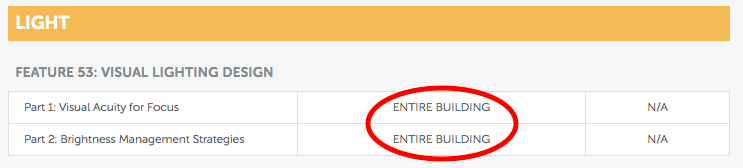
- The Core and Shell applicability determination is “entire building”, which means that the Core and Shell scope must include providing compliant lighting systems in all spaces, including leased tenant spaces.
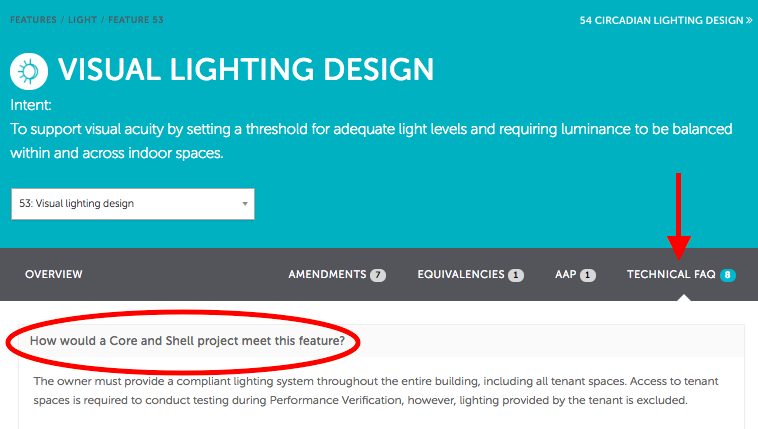
- According to the FAQ for this Feature, it is important to note that access to tenant spaces is required for Performance Verification, since a spot-check is one of the verification methods, and that any lighting provided by the tenant is excluded from the Core and Shell’s application for WELL Certification.
- Lighting that meets the requirements is installed throughout the building, including tenant spaces.
- Per the verification methods matrix, for part 1a, a letter of assurance is signed by the architect and they provide a policy document confirming part 1b and a narrative confirming part 2 (in this example, part 1c is N/A since ambient average light is above 300 lux) – the WELL Performance Testing Agent will take spot measurements of lux levels onsite during Performance Verification.
- The documents prepared during step 4 are uploaded at documentation submission and this Feature is included in the Features list to alert the WELL Reviewer that it is being pursued.
Some things to keep in mind
- An unlimited number of Not Applicable Features can be pursued.
- If one part of the Optimization Feature is Not Applicable, the project would only need to pursue the applicable Feature part to achieve the Optimization
- If all parts of the Not Applicable Feature are met, they are scored like innovations, in which an additional optimization is added but does not change the total number of optimizations available (Note: you can still achieve up to 5 additional innovation features!)
- You may always submit an Alternative Adherence Path if you’d like to propose a different way to comply with the intent of the Feature.
Still have questions?
Registered projects can reach out for WELL coaching support via the support tab of their WELL digital platform account and all others can contact us here.