Enhancements to WELL
Your guide to the Q4 2022 addenda

WELL undergoes regular maintenance where we publish amendments that clarify and enhance the WELL Building Standard (WELL Standard). These changes are based on reviews of current research as well as input from customers and industry leaders.
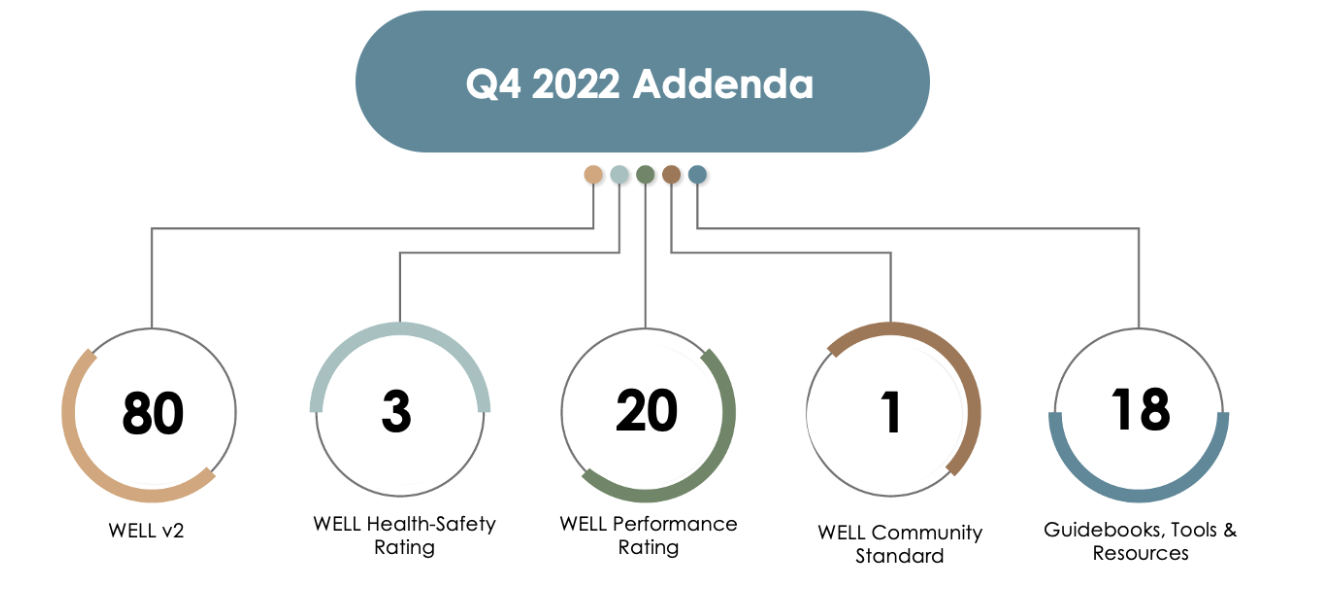
Below you will find a summary of changes. For a line by line view of all enhancements, big and small, dive in here.
Introducing the WELL Equity Rating
This quarter, updates to WELL coincide with the launch of IWBI’s latest rating, the WELL Equity Rating. This new rating empowers organizations to create places where everyone can feel welcome, seen and heard. It also gives organizations an actionable framework to validate their commitments to improving health and well-being access, celebrating diversity and prioritizing inclusivity and belonging while addressing disparities in populations that have been traditionally underserved.
Over the course of a two-year period IWBI reviewed volumes of research and engaged with hundreds of organizational leaders, practitioners and members of the community. Engagement spanned co-chair interviews, stakeholder roundtables, surveys for both employers and employees, webcasts and a community forum. IWBI also solicited select feedback from populations with lived experience.
The strategies in the WELL Equity Rating are drawn from those in the WELL Standard and have been selected to help organizations prioritize and implement equitable policies, programs and design interventions for the most marginalized people. The changes made to these features as part of the development process for the WELL Equity Rating are also reflected in the WELL Standard as a whole. Additionally, a handful of new beta features and parts were developed for inclusion in the new rating. These new strategies were also added to the WELL Standard.
To learn more about the WELL Equity Rating and how you can enroll, visit the landing page or contact wellequity@wellcertified.com.
Q4 2022 Addenda Guide
Section 1: Changes to the WELL Standard informed by the WELL Equity Rating
Changes to WELL v2 feature language informed by the WELL Equity Rating development process are generally categorized as:
- Made minor edits to feature language for clarity and simplicity.
- Updated the scope or applicability of a feature to support feasibility and impact.
- Developed new strategies to expand the reach and impact of the WELL Equity Rating and address gaps in the program based on rigorous research and industry best practices.
Summary of changes:
- W08: Hygiene Support, Parts 1 (WELL Equity Rating Feature ED2) - Clarified accessibility requirements for bathrooms including that projects must have one bathroom per floor that accommodates a person who uses a wheelchair and a care attendant.
- N09: Special Diets (WELL Equity Rating Feature ES7) - Expanded feature language to require meals without soy and sesame and labeling foods when they contain these ingredients.
- L09: Occupant Lighting Control (WELL Equity Rating Feature ED9) - Updated task lighting requirements to clarify that the light levels and position of the fixture on the work surface must be adjustable and that the light-emitting element must not be visible to users (e.g., the bulb is shielded to prevent glare). In addition, the verification type was changed from an on-site performance test to product specification sheets.
- V11β: Enhanced Ergonomics, Part 1 (WELL Equity Rating Feature ED6) - Removed the requirement that asked projects to incorporate ergonomics into their mission statement. This change recognizes that projects enrolled in WELL at scale may not be pursuing the relevant feature where the mission statement would be captured, therefore making the strategy more difficult to implement and document holistically for an organization.
- M06: Restorative Opportunities, Part 1 (WELL Equity Rating Feature EB5) - Streamlined language by removing the limits on work-related communication outside of shift or business hours.
- C06: Health Services and Benefits, Part 1 (WELL Equity Rating Feature EB1) - Removed mental health services from this feature as it is covered throughout the Mind concept, notably in Feature M03: Mental Health Services.
- Added a new beta strategy to this feature. Part 5 now covers a variety of inclusive and complementary health care services including doulas, fertility services, nutrition support and more. Projects or organizations are required to offer at least four services to employees and their designated dependents.
- C09: New Mother Support (WELL Equity Rating Feature ES1) - Adjusted requirements to clarify that pumping breaks should be available to employees at least every three hours, that access to refrigeration is required for all overnight trips and that microwave ovens must be present in lactation rooms.
- C10: Family Support, Part 1 (WELL Equity Rating Feature EB6) - Clarified that feature requirements apply to employees and added more robust examples to reflect the types of policies and services that comply with feature requirements.
- C12: Diversity and Inclusion (WELL Equity Rating Features EE1, EH1, EH2) - Split feature into three, one-point parts to facilitate greater clarity of feature requirements and emphasize the importance and impact of each component. Part 1 requires that organizations evaluate their diversity representation, create goals and implement policies that support employees. Part 2 requires that organizations create reporting policies and have an executive level sponsor of DEI initiatives whose role is dedicated to the organization’s DEI strategy. Part 3 requires organizations to establish equitable hiring and retention policies with an emphasis on wage transparency and fair compensation.
- C19B Education and Support (WELL Equity Rating Feature EB10) - Published a new strategy that requires financial support for education and/or mentoring opportunities to support career advancements and financial stability for all.
- Research has shown that creating supportive programs for education, mentorship and sponsorship can positively impact employee financial health and opportunities. Specifically, minorities and women significantly benefit from peer-to-peer mentors and sponsors who champion them. Mentorship surveys also reveal satisfaction amongst employees within such programs – in the United States, 71% of employees with a mentor say their company provides them with excellent or good opportunities to advance their careers. Research from the United States found that 80% of employees agreed that their employer’s tuition assistance program makes them more likely to stay with the organization, and 71% of respondents rated tuition assistance as the best or among the best benefits offered by their employer (excluding health care benefits).
- C20B Historical Acknowledgement (WELL Equity Rating Feature EC3) - Published a new strategy that requires a comprehensive, co-created program that acknowledges the history of colonization, displacement and relocation in a particular place and/or the contributions that Indigenous, enslaved and migrant peoples have made to a place.
- Specific ethnic and racial populations have historically been colonized, enslaved, marginalized, abused and neglected with the threat of erasure due to imperial power dynamics and laws and decrees across the globe. Research has shown these harmful practices have led to disparities in physical, mental, emotional and economic well-being, long-term displacement, erased histories, and a breakdown of community social and economic structures. The act of reconciliation illuminates and drives awareness of historical contributions of marginalized and colonized communities through action and future-facing programs (i.e., land acknowledgments, truth and reconciliation practices, empowerment programs, financial relief and economic development). These programs help support the populations they serve through a co-creation approach.
Section 2: WELL v2
- Extra Points: Streamlined the way that extra points carry over from the 10 WELL concepts to the Innovation concept. If a project achieves more than 12 points in any concept, the additional points are now automatically counted toward Innovation Feature I01, without teams needing to take any action. Note that projects can earn up to 10 points in the Innovation concept.
- Photographs: Added guidelines to the verification tab of the digital standard for features verified by a photograph including the specific information photographs should show and the number of photographs expected.
- W02 Drinking Water Quality: Updated the verification type to an on-site performance test to bring all water tests in Features W01, W02, and W04 under the scope of the WELL Performance Testing Agent.
- V03 Circulation Network: Revised feature language to require stairwells to be at least as prominent (instead of more prominent) than elevators to recognize typical building design and the important role that building circulation plays in equitable access to spaces.
- V04 Facilities for Active Occupants: Added language indicating that bike parking in Part 1 and showers, lockers, and changing facilities in Part 2 must be provided at no cost.
- S02 Maximum Noise Levels: Added line breaks to clarify the applicable room type categories, which better allows WELL Performance Testing Agents to determine the number of testing points.
- S03 Sound Barriers:
- Added new adjusted thresholds to the tables in Parts 1 and 2. Projects that also achieve Feature S06 Part 1 are eligible to demonstrate compliance with less stringent STC or Rw thresholds.
- Removed thresholds for sound source rooms that are not enclosed in Part 2 Option 2 to align with industry best practices.
- Clarified that walls separating two “enclosed quiet zones” always use the same threshold, whether or not they include enclosed offices. This change improves the feasibility for enclosed offices.
- S04 Reverberation Time: Clarified room types in S04 similar to the change made to Feature S02 described above. Distinct room types were split into their own lines in the table and sampling requirements in these spaces were also clarified in the Performance Verification Guidebook (see below).
- X10 Pest Management and Pesticide Use: Added Option 2: Certified Pest Management, which requires the project contract with an accredited service provider to implement the pest management program. Current accreditations include GreenShield, GreenPro and EcoWise. This change supports feasibility and streamlines documentation for project teams.
Section 3: WELL Ratings
- Innovation Points: Increased available innovation points from three to five to support creativity. All WELL ratings now include five available innovation points. Explore pre-approved innovations in the digital standard to be awarded for doing things like having a WELL AP on your project team or submit a novel idea for review. Explore this knowledge base tutorial to learn how to submit a strong proposal.
Section 4: Performance Verification
- Device Requirements: Decreased accuracy requirements for chlorine measurements from + 0.02 to + 0.05 mg/L, enabling broader access to devices that measure / analyze chlorine in drinking water.
- Laboratory Requirements: Clarified that the accreditation must be for the specific test methods used to analyze the parameters assessed for WELL. Note that WELL requires that labs processing samples have certain accreditations from ILAC signatories or government-recognized organizations.
- Thermal Comfort: Clarified that the accuracy requirements for relative humidity measurement devices refers to percentage points (and not a percentage of the relative humidity reading). Also, clarified that the use of a tolerance to determine feature compliance applies only thresholds related to relative humidity (as in Feature T07) and not when humidity is used as an input for Predicted Mean Vote (as in Feature T01).
- Sound: We made several updates on how the number of measurement locations is calculated.
- Background Noise Levels: Simplified calculations to determine the number of measurement locations across room types. In some cases, this will decrease the number of measurements required for large rooms (such as open offices and dining areas) and increase the number of measurements required in smaller rooms (such as enclosed offices or conference rooms).
- Sound Insulation: Clarified that calculations are based on combinations of source rooms and receiver rooms, rather than only source or only receiver rooms. For example, a project with enclosed quiet zones with walls that border both circulation zones and enclosed offices requires a test on both of those room type combinations.
- Reverberation Time: Simplified process selecting measurement locations and clarified that while the volume of a room may impact the reverberation time threshold, it does not affect the designation of “room type” for the purpose of calculating the number of required measurements.
Section 5: Program Guidebook
- Feature reverification for ratings and WELL at scale. All projects need to renew or recertify to maintain their achievements and timelines depend on the achievement and enrollment type for that location. To simplify this process, locations within a WELL at scale subscription that have achieved a rating no longer need to manually confirm each year that the features are still met; instead, the features will be automatically renewed, provided that they are supported by active documentation (including performance testing results where relevant).
- In addition, to align with WELL at scale processes, for documentation that does not already require annual submission, we also removed annual auditing requirements for locations that have achieved a rating within a WELL at scale subscription.
- Milestone award and WELL at scale. Clarified that for WELL at scale clients, location milestones (e.g., WELL Certification) are formally awarded at the end of a review cycle and not during the preliminary round of review.
Section 6: Changes impacting WELL Core projects
- A11 Source Separation: Added an additional point earning opportunity for projects that meet requirements in all leased spaces instead of non-leased spaces.
- T04 Individual Thermal Control: Added an additional point earning opportunity in Parts 1 and 2 for projects that meet requirements in all leased spaces instead of in the entire building.
How can my project or organization use updated feature language?
To upgrade to a newer version of WELL (e.g., upgrade from WELL v2 pilot to WELL v2) reach out to IWBI via your support tab in the WELL platform.
– or –
If you’re looking to leverage newer versions of specific WELL features, projects can simply make a note in their documentation submission. To avoid this extra step streamline your work, consider upgrading your entire project or portfolio to a newer version.
Dive into this knowledge base tutorial to learn more about upgrading to a newer version of WELL.
Question?
Questions about any of the changes published to the WELL Program this quarter? Reach out to our support team via your Support Tab in the WELL platform. Customers who are not yet enrolled in WELL may contact technical@wellcertified.com.